
Most retailers think inventory costs come from buying too much stock.
The reality is more complicated.
Every product sitting too long on a shelf ties up cash. Every stockout means a lost sale. And every inaccurate forecast chips away at already thin retail margins.
That’s why retailers like Walmart rely heavily on AI—not just to track inventory, but to predict demand, optimize replenishment, and make smarter decisions before problems arise.
The good news? You don’t need Walmart’s size or budget to apply the same principles. Today’s AI tools make inventory intelligence accessible to retailers of every size.
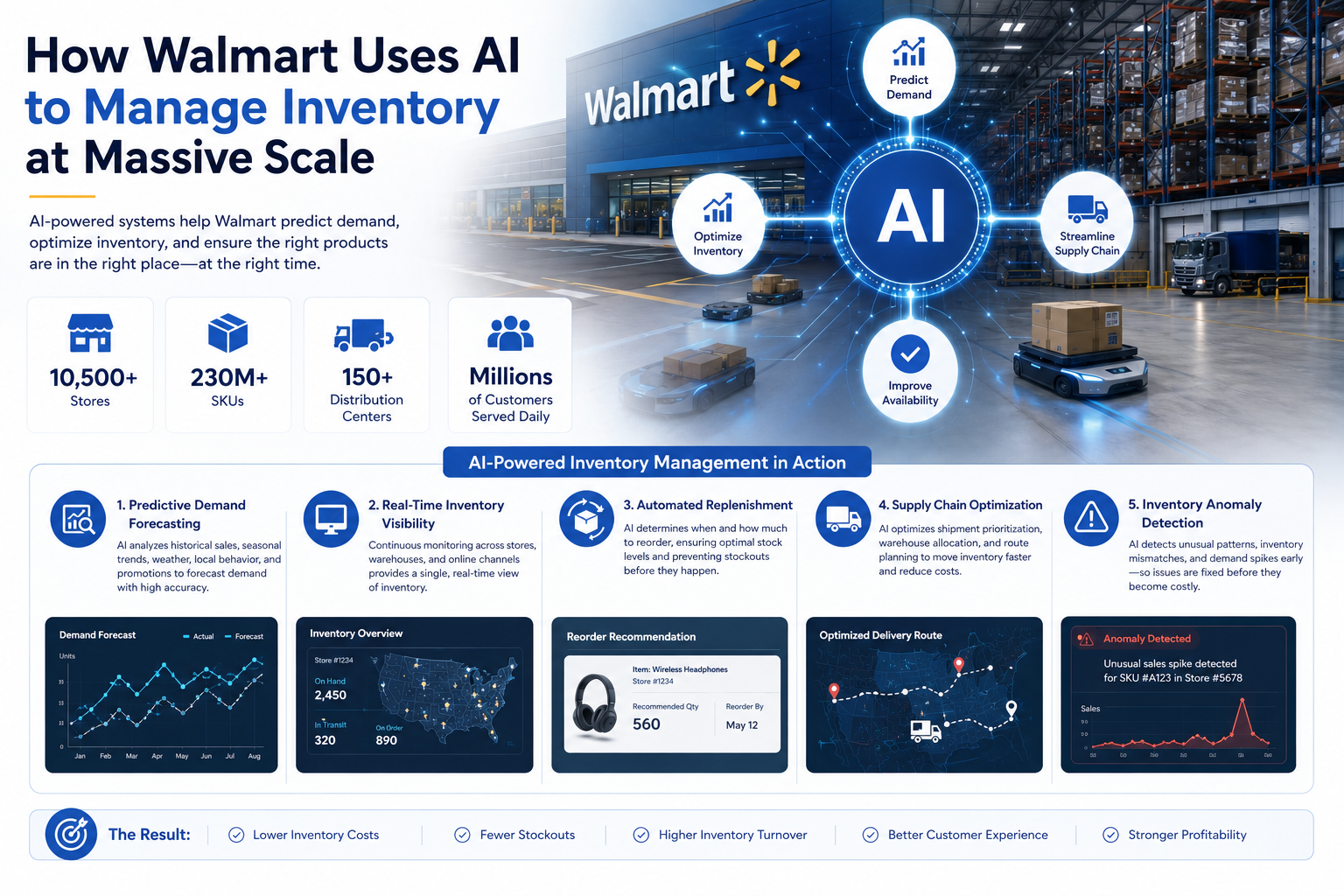
AI Systems Walmart Uses to Reduce Inventory Costs
Managing inventory across thousands of stores and millions of products is no small task. Traditional inventory management methods often struggle to keep up with changing customer demand, supply chain disruptions, and regional buying patterns. To overcome these challenges, Walmart has invested heavily in AI-powered systems that help optimize inventory levels, reduce waste, and improve product availability.
While the scale of Walmart’s operations is unique, the underlying AI strategies can be applied by retailers of any size.
Predictive Demand Forecasting
One of the biggest reasons retailers end up with excess inventory or frequent stockouts is inaccurate demand forecasting. Walmart uses AI to predict future demand with far greater precision than traditional forecasting models.
What the AI Analyzes? Rather than relying solely on historical sales data, AI evaluates multiple variables simultaneously to understand how demand is likely to change.
Historical Sales Data: AI studies past sales patterns to identify recurring trends and establish demand baselines for individual products.
Seasonal Trends: Products often experience predictable fluctuations throughout the year. AI factors in seasonal demand cycles such as back-to-school shopping, holiday sales, summer products, and winter essentials.
Local Buying Behavior: Customer preferences can vary significantly between regions. A product that sells quickly in one location may move much slower in another. AI helps Walmart adjust inventory levels based on store-specific purchasing behavior.
Weather Patterns: Weather conditions can have a major impact on consumer demand. For example, forecasts of extreme heat may increase demand for beverages and cooling products, while storms can drive purchases of emergency supplies.
Promotions and Holidays: Marketing campaigns, discounts, and major shopping events can dramatically influence purchasing behavior. AI incorporates these factors into demand predictions to prepare stores accordingly.
Business Impact: The result is a more accurate understanding of future demand, allowing Walmart to make smarter inventory decisions.
- Reduced overstock and excess inventory
- Improved forecasting accuracy
- Better replenishment planning
- Increased product availability
- Lower inventory carrying costs
Real-Time Inventory Visibility
Having inventory is not enough. Retailers also need accurate, up-to-date visibility into where products are located and how quickly they are moving. Walmart uses AI-driven inventory monitoring systems to maintain real-time visibility across stores, warehouses, and distribution centers.
How It Works?
- Continuous Inventory Monitoring: Inventory levels are tracked constantly rather than through periodic manual checks. This provides a live view of stock availability.
- Store-Level Stock Tracking: AI helps monitor inventory at individual store locations, ensuring managers have accurate information about product availability.
- Warehouse Inventory Synchronization: Inventory data from distribution centers and warehouses is integrated into a centralized system, enabling seamless coordination across the supply chain.
This visibility is particularly important for omnichannel retail operations where inventory may be sold through physical stores, websites, and mobile applications simultaneously.
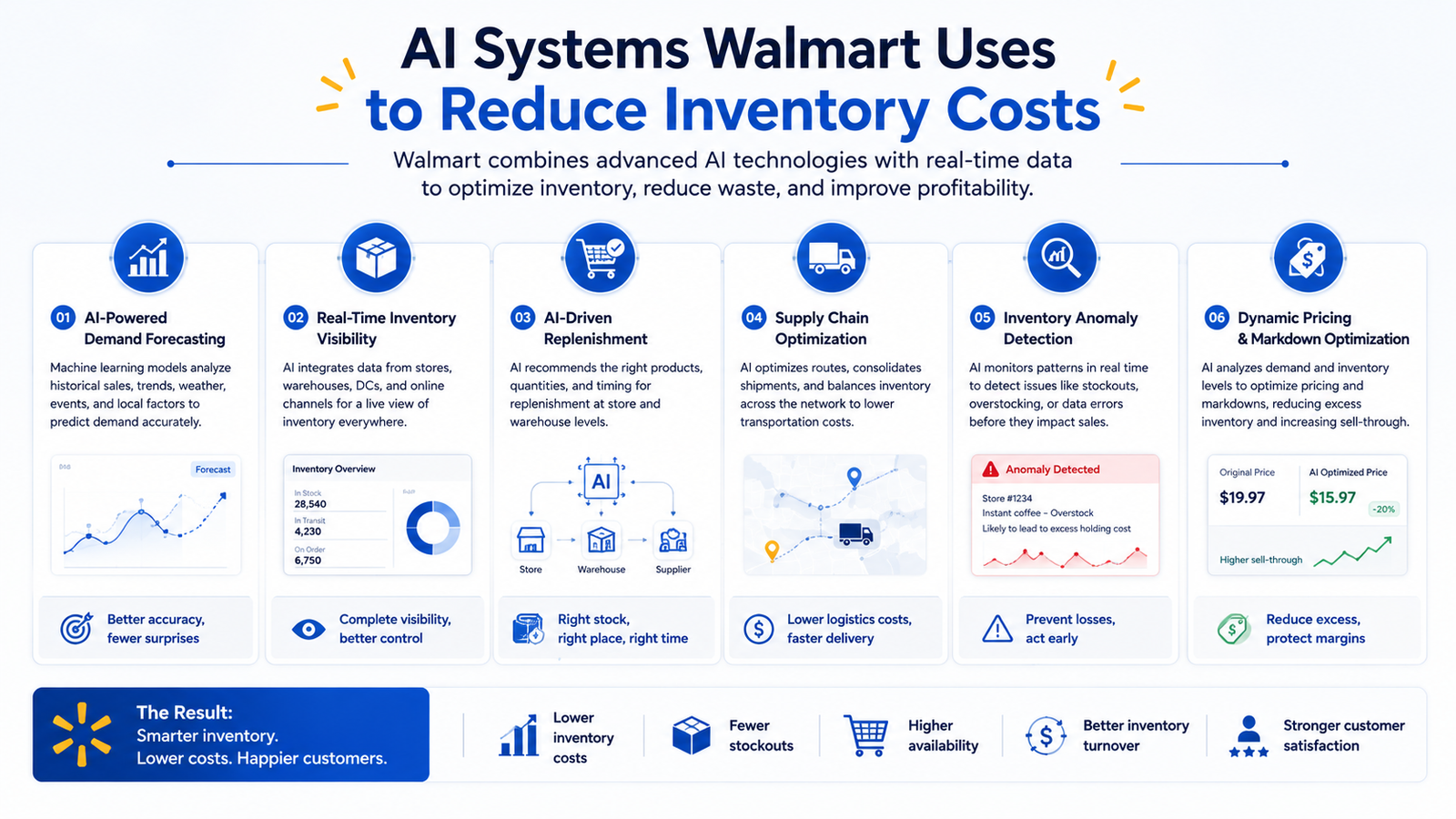
Automated Replenishment
Manual replenishment planning becomes increasingly difficult as inventory complexity grows. Walmart uses AI to automate many replenishment decisions, helping ensure products are reordered at the right time and in the right quantities.
- Predicts Reorder Timing: AI continuously evaluates sales velocity and inventory levels to determine when products should be reordered before stock reaches critical levels.
- Determines Optimal Order Quantities: Instead of relying on fixed reorder rules, AI calculates the ideal order size based on demand forecasts, lead times, and current inventory conditions.
- Prevents Stockouts Before They Happen: Potential shortages can be identified days or weeks in advance, allowing proactive replenishment rather than reactive purchasing.
- Cost Reduction Benefits: Automated replenishment creates significant operational efficiencies.
- Lower emergency procurement costs
- Reduced reliance on expedited shipping
- Fewer stockouts and lost sales
- Lower excess inventory levels
- Improved inventory turnover
By ordering smarter rather than simply ordering more, Walmart minimizes unnecessary inventory costs while maintaining product availability.
Supply Chain Optimization
Inventory costs are influenced not only by what retailers stock but also by how products move through the supply chain. Walmart leverages AI to optimize distribution and logistics decisions across its network.
- Shipment Prioritization: AI identifies which products should be moved first based on demand forecasts, inventory levels, and store requirements.
- Warehouse Allocation: Products can be distributed strategically across fulfillment centers and warehouses to ensure inventory is positioned where demand is expected.
- Route Optimization: AI helps determine the most efficient transportation routes, reducing delivery times and logistics costs.
When products move efficiently through the supply chain, less capital remains tied up in idle inventory.
Inventory Anomaly Detection
Even with accurate forecasting and replenishment systems, unexpected issues can still occur. This is where AI-powered anomaly detection becomes valuable. Anomaly detection systems continuously monitor inventory and sales data to identify unusual patterns that may indicate operational problems.
- Unusual Sales Spikes: AI can identify sudden demand increases that differ from expected patterns and trigger alerts before inventory shortages occur.
- Inventory Mismatches: Discrepancies between recorded inventory and actual stock levels can be detected quickly, reducing errors and improving accuracy.
- Shrinkage Patterns: AI can help identify unusual inventory losses that may result from theft, damage, or process inefficiencies.
- Forecast Deviations: When actual sales differ significantly from predicted demand, AI flags the issue so teams can investigate and adjust plans accordingly.
Inventory issues often remain hidden until they become expensive problems. AI enables retailers to act earlier and minimize financial impact.
- Prevents revenue leakage
- Reduces inventory waste
- Improves forecasting accuracy
- Enhances operational visibility
- Supports better inventory decision-making
For large retailers like Walmart, even small inventory anomalies can translate into millions of dollars in costs. AI helps identify these risks before they escalate, protecting both profitability and customer satisfaction.
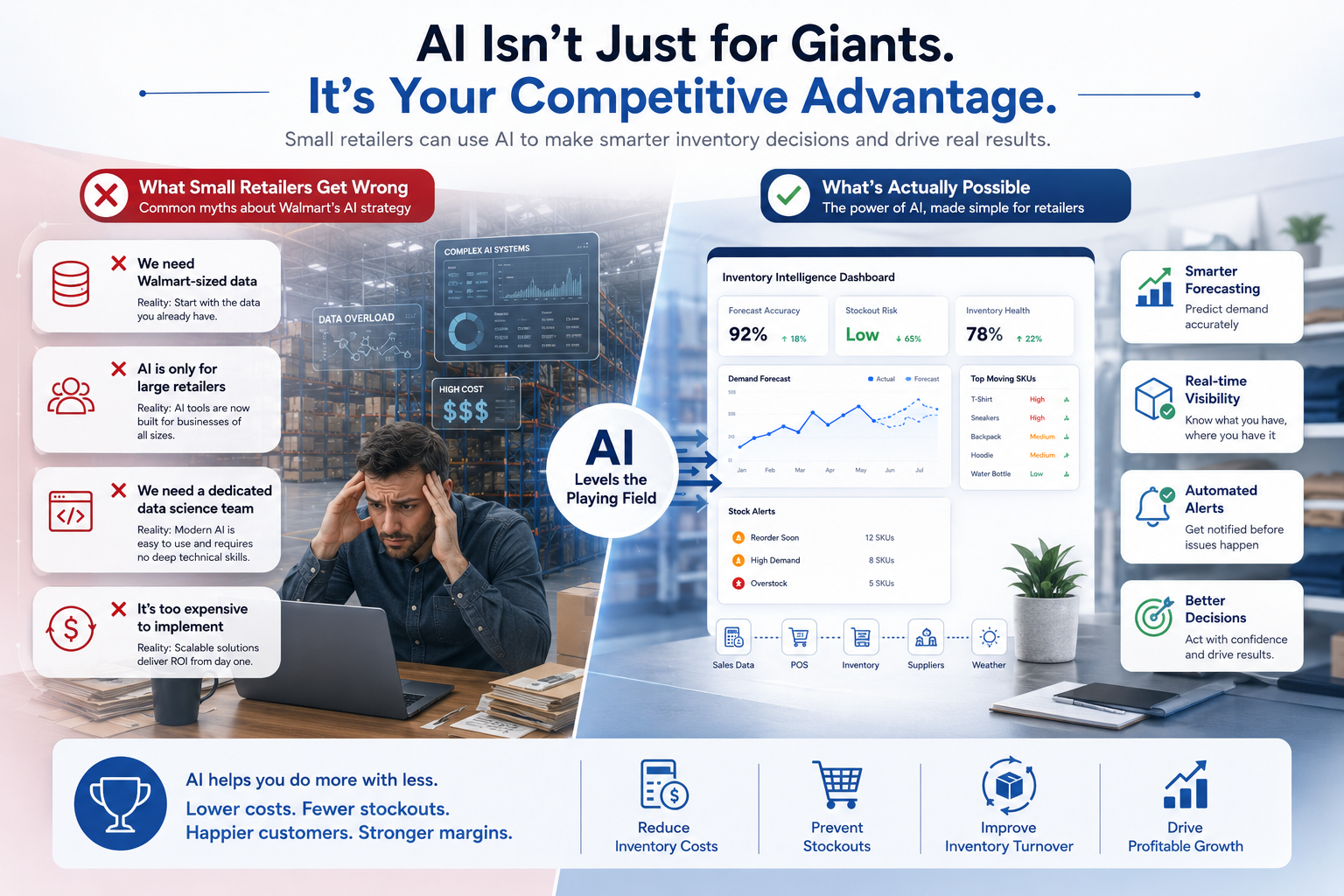
Practical AI Use Cases for Small and Mid-Sized Retailers
You don’t need Walmart’s scale to benefit from AI-powered inventory management. Many small and mid-sized retailers are already using AI to improve forecasting, reduce waste, and make smarter inventory decisions. Here are a few practical applications that can deliver immediate value.
- Predicting Stockouts Before They Happen: AI can analyze sales trends, inventory levels, and supplier lead times to identify products that are likely to run out soon. This allows retailers to replenish inventory proactively and avoid lost sales caused by stock shortages.
- Identifying Slow-Moving Inventory: Not every product contributes equally to revenue. AI can highlight items that are sitting on shelves for too long, helping retailers plan promotions, discounts, or inventory adjustments before excess stock becomes a financial burden.
- Optimizing Seasonal Purchases: Seasonal demand can be difficult to predict. AI uses historical sales data and market trends to forecast demand more accurately, helping retailers stock the right products in the right quantities during peak seasons.
- Reducing Markdown Losses: By identifying products that are likely to become overstocked, AI enables retailers to take action earlier through targeted promotions or inventory redistribution, reducing the need for deep discounting later.
- Detecting Inventory Anomalies: AI can automatically flag unusual inventory patterns such as sudden sales spikes, stock discrepancies, or unexpected inventory losses. Early detection helps retailers resolve issues faster and maintain accurate inventory records.
These use cases demonstrate that AI is no longer reserved for enterprise retailers. Even smaller businesses can use AI-driven insights to improve inventory performance, protect margins, and make more confident operational decisions.
How Aximise Helps Retailers Build Walmart-Style Inventory Intelligence?
You don’t need Walmart’s budget to make smarter inventory decisions. Aximise helps retailers use AI to gain better control over inventory, improve forecasting accuracy, and reduce operational costs.
Our solutions help retailers:
- Forecast demand more accurately using AI-driven insights.
- Monitor inventory in real time across stores and warehouses.
- Detect inventory anomalies before they impact revenue.
- Optimize replenishment decisions to reduce stockouts and excess inventory.
- Turn inventory data into actionable insights through intuitive analytics and reporting.
By integrating AI into everyday inventory operations, Aximise helps retailers improve efficiency, protect margins, and make faster, data-driven decisions.
Ready to Optimize Your Inventory with AI? Talk to our team to discover how AI can help you reduce inventory costs, improve product availability, and build a more resilient retail operation.