
At 8:47 a.m., the front desk phone rings.
The receptionist is checking out guests. Housekeeping is waiting for room updates. A manager needs yesterday’s occupancy report.
The phone rings again.
Nobody answers.
It’s just one missed call. But the guest books elsewhere. A direct booking disappears, an OTA commission may get added, and another small piece of the hotel’s margin quietly vanishes.
Now multiply that by missed calls, repetitive guest questions, hours of manual reporting, delayed maintenance, inefficient housekeeping, unnecessary overtime, and employees constantly moving data between systems.
None of these looks like a major expense on its own. Together, they can quietly eat into hotel profitability.
That matters even more in today’s environment. In a 2026 survey from the American Hotel & Lodging Association, hotel owners and operators cited rising costs for goods and supplies, labor, utilities, insurance, and ongoing workforce shortages among their biggest financial pressures.
Hotel owners can’t fully control insurance premiums, utility rates, wage inflation, franchise fees, or changes in travel demand.
But they can control more of what happens inside their operation.
The problem isn’t necessarily a lack of software. Many hotels already use some combination of a PMS, booking engine, OTA platforms, accounting tools, payroll systems, spreadsheets, maintenance tools, and communication apps.
The bigger problem is everything happening between those systems: the manual work employees still have to check, copy, call, update, reconcile, and follow up on.
Whether you operate one independent motel, a branded hotel, or several franchise properties, those small inefficiencies can create significant hidden hotel operating costs.
So, where are hotel profits really leaking?
10 Hidden Operational Costs Eating Into Hotel Profits
Hotel margins aren’t only affected by major expenses such as payroll, insurance, utilities, and franchise fees.
Small inefficiencies across bookings, staffing, maintenance, guest service, and reporting can also add up. Here are 10 areas where hotel owners may be losing money without realizing it.
1. Missed Calls and Lost Direct Bookings
A potential guest calls about availability, rates, parking, pet policies, early check-in, or a reservation change.
If the front desk is busy and nobody answers, that inquiry may disappear.
The guest may book somewhere else or later make the same reservation through an OTA, increasing the property’s acquisition cost.
A single missed call may not matter. Repeated every day, it can.
Hidden cost: Lost booking opportunities, higher acquisition costs, and staff time spent returning calls.
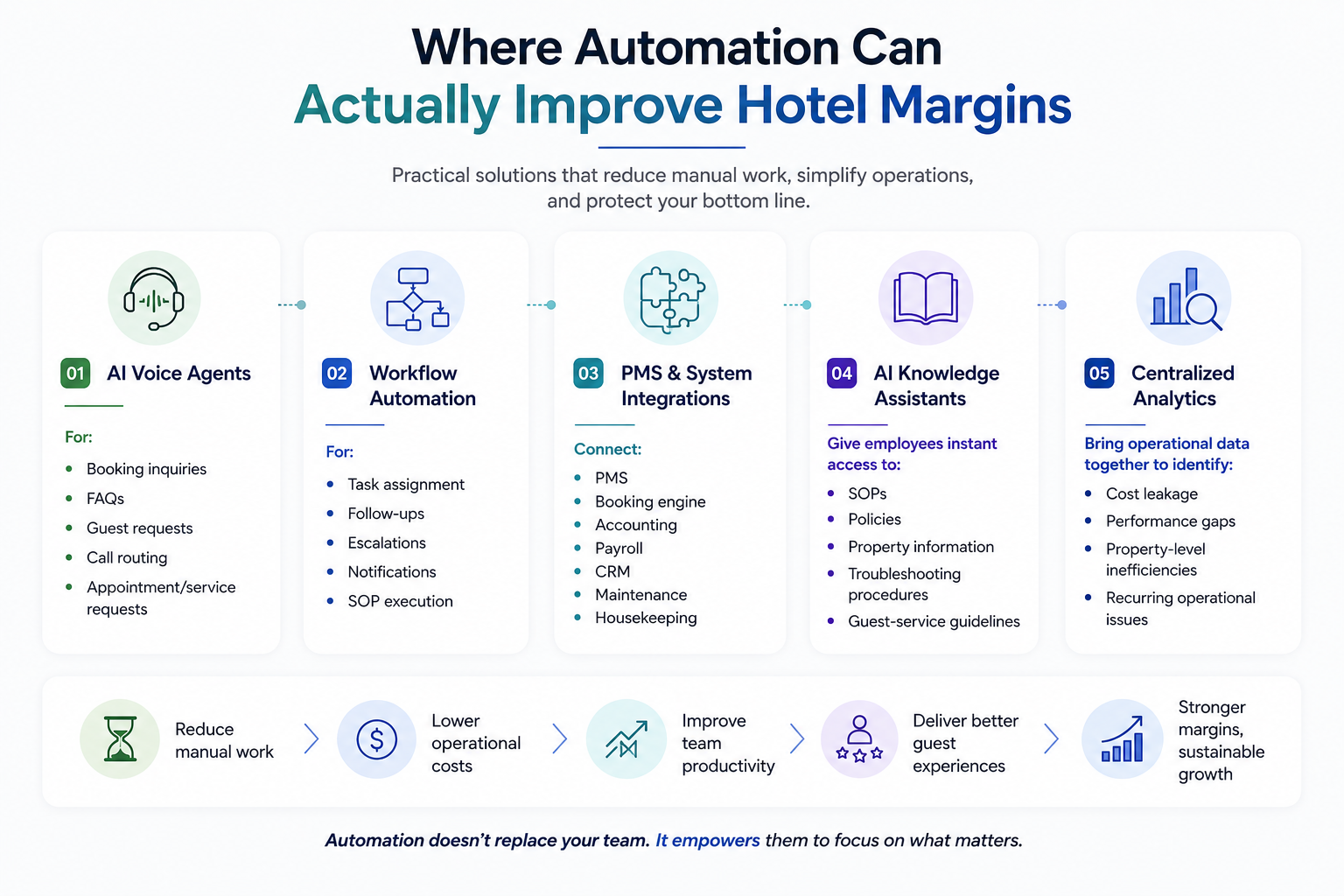
Automation opportunity: AI voice agents can answer routine inquiries, provide property information, capture booking requests, and route complex conversations to staff.
The goal is not to replace the front desk. It is to keep staff from having to choose between the guest standing in front of them and every routine phone call.
2. Repetitive Front-Desk Questions
What time is breakfast?
Is parking free?
Do you allow pets?
What time is check-out?
Do you have a pool?
Can I request late check-out?
Each question takes only a few minutes, but employees may answer the same questions dozens of times across phone calls, website chats, text messages, and in-person conversations.
The bigger cost is interruption. Staff repeatedly stop higher-value work to retrieve information that rarely changes.
Hidden cost: Labor spent on repetitive tasks and reduced staff availability for more important guest needs.
Automation opportunity: AI voice, chat, and digital guest assistants can answer common questions using property-specific information while escalating exceptions to staff.
3. Manual Reporting
Many general managers still pull information from PMS reports, payroll systems, accounting tools, spreadsheets, guest-review platforms, and maintenance logs before they can see the full picture.
For a single hotel, that can consume several management hours per week.
For a multi-property operator, the same process can be repeated across every location.
For example, if a manager spends five hours each week preparing and reconciling reports, that adds up to more than 250 management hours per year.
Hidden cost: Administrative labor, data-entry errors, inconsistent reports, and delayed decisions.
Automation opportunity: Automated reporting, system integrations, scheduled data flows, and centralized dashboards can reduce manual consolidation.
4. Inconsistent SOP Execution
Your SOP may say one thing.
What actually happens on a busy Saturday night may be something completely different.
Different employees, shifts, and properties may handle refunds, guest complaints, maintenance issues, room inspections, system outages, or housekeeping exceptions differently.
When procedures live inside PDFs, binders, shared drives, email threads, or one manager’s memory, employees often have to ask someone for help.
Hidden cost: Operational errors, inconsistent guest experiences, excessive management interruptions, and additional training time.
Automation opportunity: Centralized SOP libraries, workflow automation, and AI knowledge assistants can help employees find approved answers quickly and follow consistent processes.
This becomes especially valuable for franchise and multi-property owners trying to standardize operations across locations.
5. Late Maintenance Detection
A small maintenance issue can become an expensive repair if nobody follows up quickly.
A leaking fixture can create water damage. An HVAC problem can take a room out of service. A recurring equipment issue may be repaired several times because nobody sees the full service history.
For many independent hotels and motels, the first opportunity is not advanced predictive maintenance.
It is better visibility and accountability.
Hidden cost: Repair expenses, room downtime, emergency service calls, repeat maintenance, and lost room revenue.
Automation opportunity: Digital maintenance requests, preventive-maintenance schedules, automatic escalation, recurring issue tracking, and asset histories.
For properties with sufficient equipment and historical data, predictive maintenance can provide an additional layer of insight.
6. Housekeeping Inefficiency
Housekeeping sits directly between a checked-out room and the next paying guest.
But room-status communication is not always immediate.
A room may already be clean while the front desk still sees it as unavailable. Housekeepers may wait for assignments. Inspectors may not know which rooms are priorities. Staff may rely on calls or text messages to update room status.
Those delays are operational, but they can also affect revenue.
Hidden cost: Wasted labor, slower room turnover, delayed check-ins, and rooms unnecessarily unavailable for sale.
Automation opportunity: Real-time PMS and housekeeping integrations, automated room-status notifications, and prioritized cleaning queues can reduce waiting and manual communication.
7. Inefficient Staffing and Overtime
Labor remains one of the most significant cost pressures for U.S. hotel operators. In AHLA’s 2026 survey, 65% of respondents cited labor costs as a financial pressure, and more than half reported being somewhat or severely understaffed.
Staffing too heavily increases payroll.
Staffing too lightly can lead to overtime, slower service, manager burnout, and guest complaints.
The problem is often not simply the number of employees. It is matching labor to expected workload.
Hidden cost: Avoidable overtime, unnecessary payroll, reduced productivity, and inconsistent service.
Automation opportunity: Occupancy forecasts, historical workload patterns, arrival and departure data, event calendars, and scheduling analytics can help managers make better staffing decisions.
AI is not required for every schedule. Better use of existing data can already improve labor planning.
8. Unnoticed Guest Complaints
One negative review gets attention.
But recurring problems are often spread across Google reviews, OTA platforms, surveys, emails, front-desk notes, and support messages.
A manager may see each complaint individually without recognizing a larger pattern.
Perhaps multiple guests mention room cleanliness.
Maybe breakfast complaints are increasing.
Maybe several reviews mention the same maintenance issue.
The cost is not simply a bad review. The real cost is failing to identify a repeatable operational problem.
Hidden cost: Lost repeat business, guest dissatisfaction, reputation damage, and missed opportunities to correct recurring issues.
Automation opportunity: Review monitoring, feedback aggregation, sentiment analysis, and automated alerts can identify recurring themes and help management act sooner.
The value is not generating a sentiment score. It is turning scattered guest feedback into operational information.
9. Managers Moving Data Between Systems
Your PMS knows part of the story.
Payroll knows another.
Accounting has another piece.
Guest reviews live somewhere else.
Maintenance may be tracked in another system or spreadsheet.
In many hotels, the manager becomes the integration layer.
Employees export reports, copy numbers into spreadsheets, send emails, manually update records, and reconcile information just to understand what happened.
Hidden cost: Lost management productivity, data-entry errors, duplicated work, and delayed decisions.
Automation opportunity: APIs, integrations, workflow automation, and AI-assisted data processing can move information between systems without requiring employees to do it manually.
This is often one of the most overlooked hotel operating costs because it appears as “normal management work.”
10. Lack of Portfolio-Level Visibility
A single property may be able to manage with local reports and direct communication.
That approach becomes much harder when an owner operates several hotels.
Which property has the highest overtime?
Where are maintenance costs increasing?
Which location is generating repeated guest complaints?
Where are rooms turning more slowly?
Which property is spending more on supplies?
Where are direct bookings underperforming?
If answering those questions requires calling several general managers and waiting for spreadsheets, the owner does not have real-time operational visibility.
Hidden cost: Delayed decisions, inconsistent reporting, unresolved problems, and missed opportunities to compare performance across properties.
Automation opportunity: Centralized dashboards, cross-property analytics, standardized workflows, and shared reporting can give ownership teams a clearer portfolio-level view.
One missed call may seem insignificant.
So does one spreadsheet, one delayed repair, one inefficient shift, or one employee repeatedly looking for the same SOP.
But multiplied across hundreds of rooms, thousands of guest interactions, and multiple properties, those small leaks can materially affect profitability.
The goal is not to add more technology.
It is to eliminate unnecessary work that is quietly costing the hotel money.
How to Identify Your Hotel’s Biggest Operational Cost Leaks
Before automating anything, hotel operators need to know where money and employee time are actually being lost.
A simple operational audit can reveal which processes are costing more than they appear to.
1. Map Repetitive Tasks
Look for processes employees repeatedly have to:
- Check
- Copy
- Enter
- Call
- Follow up
- Report
These are often the easiest places to find unnecessary manual work.
The question is simple:
What are employees doing repeatedly that should not require the same amount of human effort every time?
2. Put a Cost on Manual Work
Do not simply ask how long a task takes.
Calculate what it costs.
Consider:
- How often does the task happen?
- How many employees are involved?
- How many hours are spent each week?
- What does that labor cost annually?
- Does a manager also have to review or correct the work?
A task taking 30 minutes may sound insignificant.
If it happens every day across five properties, it becomes something very different.
3. Look for Revenue Leakage
Not every operational problem appears as an expense.
Look for revenue the hotel could have captured but did not.
Examples include:
- Missed reservation calls
- Lost direct bookings
- Rooms sitting unavailable longer than necessary
- Delayed guest responses
- Missed upsell opportunities
- Poor guest follow-up
- Lost repeat business
Operational efficiency is not only about cutting costs.
It is also about capturing revenue that is already within reach.
4. Find the Gaps Between Systems
Your hotel may already have a PMS, accounting platform, booking engine, payroll system, OTA platforms, and other tools.
Ask one important question:
Are those systems actually working together, or are employees manually moving information between them?
Every manual handoff is a potential cost and error point.
Before replacing existing technology, look for opportunities to connect it.
A system integration may create more value than another standalone software subscription.
For businesses evaluating broader automation or AI opportunities, Aximise’s AI Consulting & Development service focuses on identifying business value before choosing the technology.
5. Prioritize the Biggest Opportunities
Not every process needs automation.
Start with tasks that are:
- High volume
- Repetitive
- Time consuming
- Error prone
- Financially measurable
A low-value task that happens twice a month probably should not become an automation project.
A process consuming dozens of employee hours every week deserves a closer look.
The objective is not to automate everything.
The objective is to identify the few operational bottlenecks where eliminating unnecessary work can create measurable impact on hotel profitability.
How Aximise Helps Hotels Reduce Operational Leakage
Aximise helps hotel, motel, franchise, and multi-property operators identify where repetitive work, disconnected systems, and operational bottlenecks may be affecting profitability.
We start with the business problem rather than the technology.
Where is employee time being lost?
Where are manual handoffs occurring?
Where is information delayed?
Where are booking opportunities being missed?
Where are managers spending time assembling information instead of acting on it?
Once the problem is clear, the solution may involve an integration, workflow automation, centralized dashboard, AI assistant, voice agent, or custom software.
It does not always require AI.
Aximise can help hotel teams:
- Reduce repetitive manual work
- Capture more direct-booking opportunities
- Connect disconnected systems
- Improve operational visibility
- Standardize workflows across properties
- Centralize SOP knowledge
- Reduce manual reporting
- Help employees focus on higher-value guest service
You can also review examples of how Aximise approaches automation and AI in our case studies.
The principle is simple:
Use technology where it can create measurable operational value, and keep the systems that are already working whenever possible.
Hotel profits do not always disappear through one big expense.
More often, they leak through dozens of small operational inefficiencies: missed calls, repetitive questions, spreadsheets, slow room updates, delayed maintenance, inefficient staffing, disconnected systems, and incomplete information.
The good news is that fixing these issues does not always require hiring more people or replacing your hotel technology stack.
It starts by identifying where your teams spend time on work that can be eliminated, connected, automated, or simplified.
Frequently Asked Questions
What are the biggest hotel operating costs?
Major hotel operating costs typically include labor, supplies, utilities, insurance, property operations, maintenance, franchise-related expenses, and guest acquisition costs. Smaller operational inefficiencies—such as overtime, manual reporting, and missed bookings—can add additional hidden costs.
How can hotels reduce operating costs without hurting guest service?
Hotels can first reduce work guests do not value, including duplicate data entry, repetitive reporting, inefficient scheduling, manual system handoffs, and repeated routine questions. This can free employees to spend more time on higher-value guest interactions.
What hotel tasks can be automated?
Common opportunities include guest inquiries, reservation-call handling, reporting, room-status notifications, maintenance escalation, SOP searches, review monitoring, data synchronization, and cross-property reporting.
Can hotel automation work with an existing PMS?
Yes, depending on the PMS and available integrations or APIs. Automation does not necessarily replace the PMS; it can connect existing systems, move information automatically, improve reporting, or support specific guest and employee workflows.
Is hotel automation only useful for large hotel chains?
No. Independent hotels and motels can benefit when automation solves a frequent, measurable problem. Multi-property operators may gain additional value from centralized reporting, standardized workflows, shared SOP knowledge, and portfolio-level analytics.
Stop Letting Small Operational Leaks Become Large Costs
You may not be able to control every increase in labor, insurance, utilities, supplies, or franchise costs.
But you can examine how efficiently your hotel operates.
One missed call.
One repetitive task.
One manual spreadsheet.
One preventable overtime hour.
One room sitting unavailable longer than necessary.
One manager copying information from one system to another.
Individually, they look small.
At scale, they do not.
Find Out Where Your Hotel Is Losing Time and Money
Aximise’s Hotel Operations Automation Assessment is designed to help hotel, motel, franchise, and multi-property operators identify repetitive work, disconnected systems, and operational bottlenecks that may be creating unnecessary cost or revenue leakage.
We’ll review how work moves through your operation, where employees are spending unnecessary time, and which opportunities are realistic candidates for integration, automation, AI, or process improvement.
The goal is not to sell you more technology. The goal is to identify where better processes and smarter automation can create measurable business value.
Book a Hotel Operations Automation Assessment with Aximise →