
Your employees probably don’t have a knowledge problem.
They have a finding-the-right-information problem.
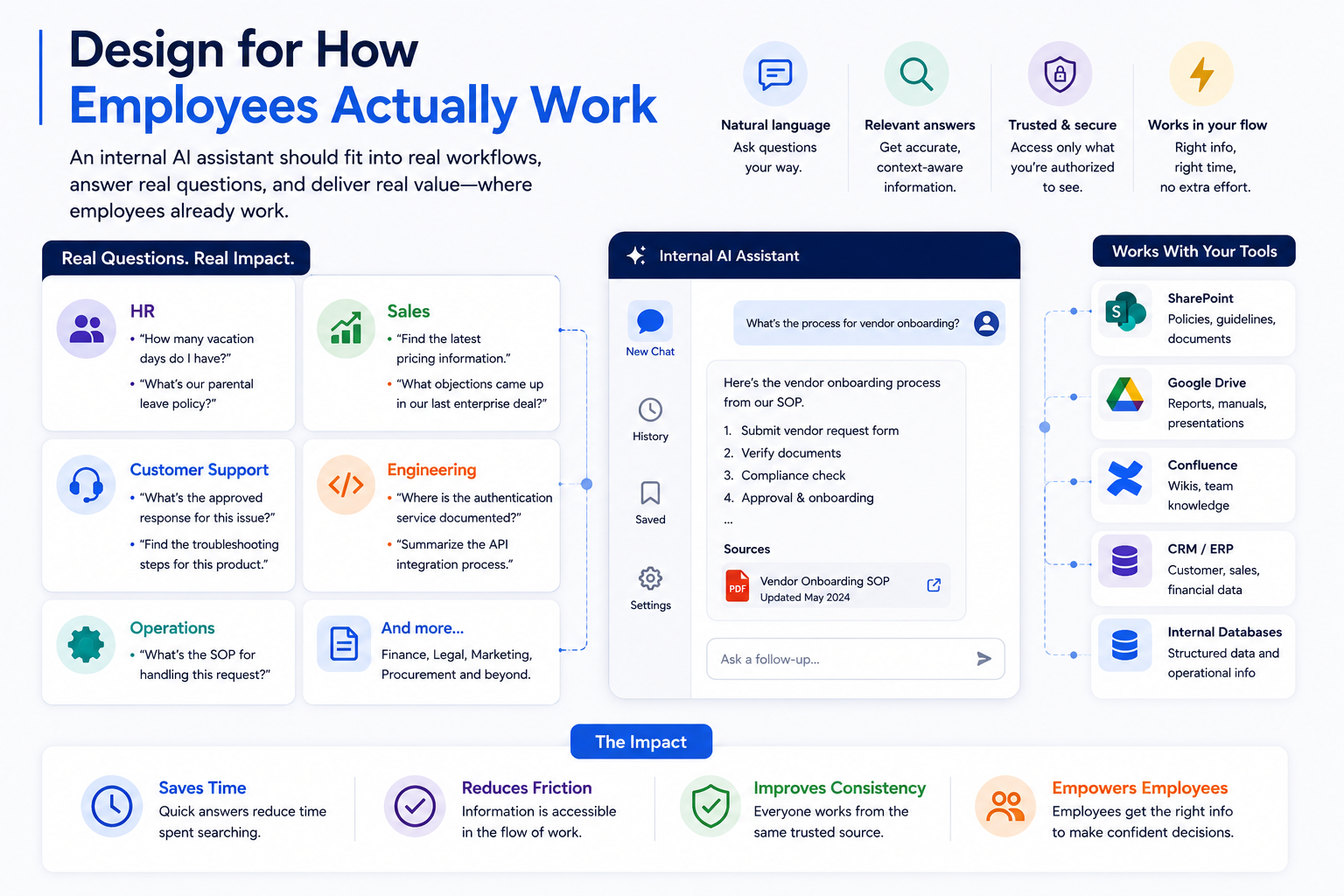
Policies are buried in PDFs. Project knowledge lives in scattered folders. Critical answers sit inside old emails, wikis, and databases. An internal AI assistant can bring all of this together, but simply connecting an LLM to company data doesn’t make employees trust it.
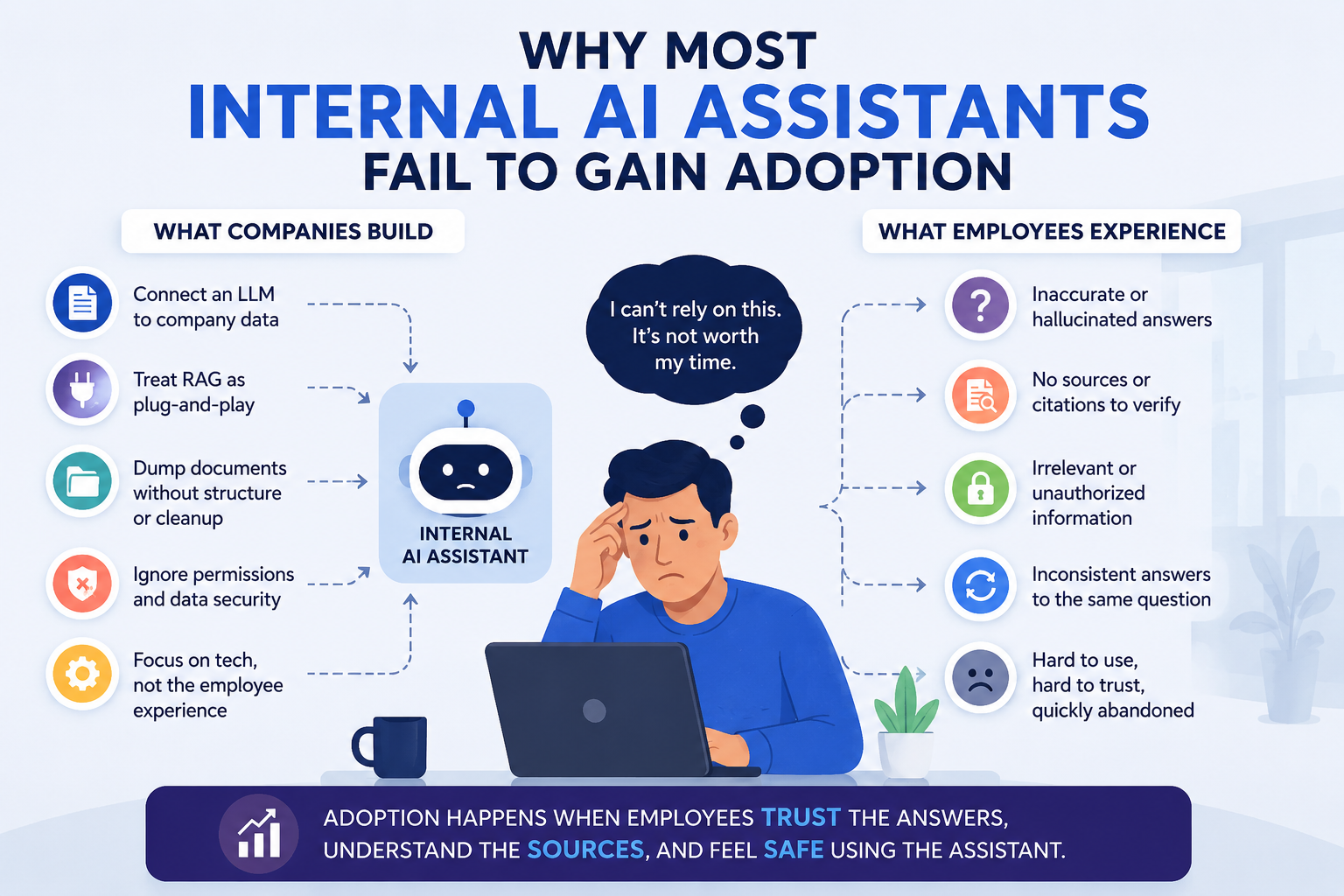
The real challenge is building an AI assistant that gives accurate answers, respects access permissions, shows where those answers came from, and knows when it doesn’t have the answer.
That’s what separates an impressive AI demo from an enterprise AI assistant employees actually depend on.
What Makes Employees Trust an Internal AI Assistant?
Trust is not created by adding a conversational interface to an LLM. Employees trust an internal AI assistant when they can rely on its answers, understand how it reached them, and use it without worrying about data security.
- Accuracy: An internal AI assistant is only as valuable as the information it provides. Its responses should be grounded in approved, relevant, and up-to-date company data rather than generating plausible-sounding answers. This requires reliable knowledge sources, effective retrieval, and mechanisms that reduce hallucinations. When an employee asks about a company policy or process, the assistant should retrieve the correct information rather than simply provide what sounds like the most likely answer.
- Transparency: Employees need to know why they should believe an AI-generated answer. Providing citations, source documents, or links to the underlying information gives users a way to verify responses. Instead of simply saying, “The expense policy allows this,” a trustworthy assistant can point employees to the specific policy document and relevant section.
- Security: Internal AI assistants often interact with sensitive business information, making access control essential. The assistant should respect the same permissions employees already have across enterprise systems. An employee should never gain access to confidential HR, financial, customer, or executive information simply because the AI can retrieve it. Authentication, role-based access, permission-aware retrieval, encryption, and auditability should be built into the architecture.
- Consistency: Employees quickly lose confidence when an AI assistant gives contradictory answers to the same question. While responses may naturally vary in wording, the underlying information should remain consistent. A strong knowledge architecture, controlled retrieval, clear system instructions, and regular evaluation help ensure that responses remain reliable and aligned with current company policies and processes.
- Usability: Even the most technically sophisticated AI assistant will fail if employees find it difficult to use. Employees shouldn’t need to learn complex prompt engineering to find a simple answer. The assistant should understand natural language, support follow-up questions, provide concise responses, and fit naturally into existing workflows.
Ultimately, trust comes from experience. When employees consistently receive accurate, secure, transparent, and useful answers, an internal AI assistant stops being another piece of software and becomes a tool they can confidently depend on.
The Architecture Behind a Trustworthy Enterprise AI Assistant
Building a trustworthy internal AI assistant requires more than connecting a large language model to a company’s documents. The architecture must ensure that information is relevant, secure, traceable, and grounded in trusted enterprise data. A typical enterprise AI assistant can be structured as:
Employee → AI Interface → Authentication → Retrieval Layer → Enterprise Knowledge → LLM → Grounded Response
Each layer plays a specific role in building trust.
- AI Interface: Where Employees Interact: The interface should feel as simple as any modern conversational AI tool. Employees can ask questions in natural language, ask follow-up questions, summarize documents, or find specific information without learning complex prompts. The goal is to make AI accessible within existing workflows rather than forcing employees to change how they work.
- Authentication & Access Control: Before the assistant retrieves any information, it needs to know who is asking and what they are allowed to access. Integration with enterprise identity systems, SSO, and role-based access controls ensures that employees only receive information they are authorized to see.
- Enterprise Knowledge Layer: The assistant needs access to the organization’s actual knowledge, not just the general information an LLM learned during training. This layer can bring together:
- Company policies and SOPs
- Product documentation
- Internal wikis
- Project documents
- CRM and ERP data
- Knowledge bases
- Reports and databases
The quality of this layer directly affects the quality of the assistant’s responses. Outdated, duplicated, or poorly structured information can lead to unreliable answers.
- Retrieval Layer: This is where Retrieval-Augmented Generation (RAG) becomes critical. When an employee asks a question, the system searches the organization’s knowledge sources and retrieves the most relevant information before sending that context to the LLM. Depending on the use case, the retrieval layer can combine:
- Semantic/vector search
- Keyword search
- Metadata filtering
- Hybrid search
- Permission-aware retrieval
A well-designed retrieval system ensures the model receives the right information at the right time, rather than relying on its general knowledge.
- LLM & Orchestration Layer: The LLM processes the employee’s question along with the retrieved enterprise context and generates a response. However, the model should operate within defined instructions and guardrails. These can control how it handles sensitive information, uncertainty, unsupported questions, and requests outside its intended scope. The orchestration layer can also manage conversation history, tool calls, workflows, and integrations with enterprise systems.
- Grounded Response Layer: The final response should be more than a confident-sounding answer. A trustworthy assistant should provide grounded responses backed by the organization’s information. Where appropriate, responses can include source citations, document names, timestamps, or links to the original content. This allows employees to verify important information instead of treating the AI as an unquestionable authority.
RAG: The Foundation of a Reliable Internal AI Assistant
A large language model alone cannot reliably answer questions about your company’s latest policies, processes, or internal knowledge. Retrieval-Augmented Generation bridges this gap by connecting the AI model to trusted enterprise data.
When an employee asks a question, the RAG system retrieves relevant information from approved sources and provides that context to the LLM before generating a response. This helps the assistant deliver answers grounded in current, company-specific information rather than relying solely on its pre-trained knowledge.
A reliable RAG architecture typically involves:
- Data ingestion: Bringing documents and enterprise data into the knowledge system.
- Chunking & indexing: Structuring information for efficient retrieval.
- Semantic or hybrid search: Finding the most relevant content based on the employee’s query.
- Permission-aware retrieval: Ensuring users only access information they are authorized to see.
- Grounded generation: Using retrieved information to generate accurate, context-aware responses.
- Source attribution: Showing employees where the answer came from.
However, RAG isn’t a plug-and-play solution. Poor data quality, outdated documents, weak retrieval, or incorrect permissions can still produce unreliable answers. Building trustworthy enterprise RAG requires continuous evaluation, monitoring, and improvement.
How to Evaluate an Internal AI Assistant Before Launch?
Launching an internal AI assistant without testing it against real employee questions is a risky move. A successful pilot should evaluate more than whether the AI can generate an answer; it should determine whether employees can trust, verify, and safely use that answer.
- Accuracy: Test whether responses are factually correct and aligned with approved company information.
- Retrieval Quality: Check whether the system consistently retrieves the right documents, sections, and data needed to answer a question.
- Groundedness: Verify that responses are actually supported by retrieved sources rather than generated from assumptions or the model’s general knowledge.
- Security: Test different user roles and permissions to ensure employees cannot retrieve information they are not authorized to access.
- Consistency: Ask similar questions in different ways and check whether the assistant delivers logically consistent answers.
- Response Time: Enterprise users expect answers quickly. Measure latency across simple questions, complex queries, and high-demand scenarios.
- User Experience & Adoption: Put the assistant in the hands of real employees. Track whether they can get useful answers without complicated prompting and whether they would choose to use it again.
- Handling Uncertainty: A trustworthy assistant should know when it doesn’t have enough information. Test whether it can say “I don’t have enough information to answer that” instead of confidently generating an unsupported response.
The goal of an internal AI assistant isn’t to make your company look more AI-powered. It’s to make your people more informed, faster, and more confident in their decisions. But trust doesn’t come from the AI model alone.
It comes from accurate enterprise data, permission-aware RAG, secure architecture, transparent answers, consistent performance, and an experience employees actually want to use.
When these pieces come together, an internal AI assistant becomes more than a chatbot. It becomes a trusted interface to your organization’s collective knowledge, helping employees find the right information without searching through countless documents, tools, and conversations.
Build an AI Assistant Your Employees Can Actually Trust
At Aximise, we help businesses turn scattered enterprise knowledge into secure, intelligent AI assistants built around their workflows, data, and business goals. Ready to turn your internal knowledge into an AI advantage? Talk to Aximise and build your enterprise AI assistant.