

“By 2026, AI won’t feel like a novelty. It’ll feel like electricity: expected, embedded, and invisible when it’s done right.” Synergy Restaurant Consultants, 2026
You didn’t get into the restaurant business to spend your nights fighting scheduling spreadsheets, chasing no-shows, or watching voicemails pile up while your front-of-house team scrambled through the dinner rush.
But here you are.
Labor costs are climbing. Turnover is relentless. And your guests bless them, don’t care that you’re two people short on a Saturday night. They just want the same great experience they had last time.
This is the reality most restaurant operators live in right now. And it’s precisely why learning how to automate restaurant operations has moved from “something big chains experiment with” to something independent owners, multi-unit managers, and franchise operators are actively building into their businesses.
This isn’t a trend piece. It’s a practical playbook backed by real operator data. By the end, you’ll know what AI automation actually does inside a restaurant, what returns real operators are seeing, how franchisees are using it to scale consistency across locations, and where to start without getting overwhelmed.
The Problem Every Operator Already Knows
Let’s be honest about the pressure before we talk about solutions.
- Labor is your highest cost and your biggest headache. More than 74% of restaurant operators expect wages to keep rising. Industry-wide turnover sits at 75% annually, meaning you’re essentially rebuilding your team every year. Finding and keeping reliable staff has become a full-time job layered on top of your actual full-time job.
- You’re bleeding revenue you can’t even see. Restaurants running lean teams miss 15–20% of inbound calls during peak hours. Those aren’t just missed calls; they’re missed reservations, missed takeout orders, missed first impressions. Here’s the number that should keep you up at night: 83% of customers will choose a competitor if their call goes to voicemail more than once.
- Over 42% of restaurant operators reported their businesses weren’t profitable in 2025. With food costs, insurance, and inflation all rising simultaneously, the margin for operational inefficiency has essentially disappeared.
- Guests don’t lower their expectations for your staffing reality. A guest who had a great experience last month holds that as the standard always, regardless of what’s happening behind the scenes on any given night.
None of this is new. But the tools available to address it have changed dramatically, and the operators who recognize that are quietly pulling ahead.
What AI Automation Actually Does in a Restaurant?
Here’s the single most important thing to understand: AI automation in restaurants isn’t robots rolling through your dining room. It’s software that handles the repetitive, time-consuming, error-prone work, so your team can focus on what actually requires a human: genuine hospitality.
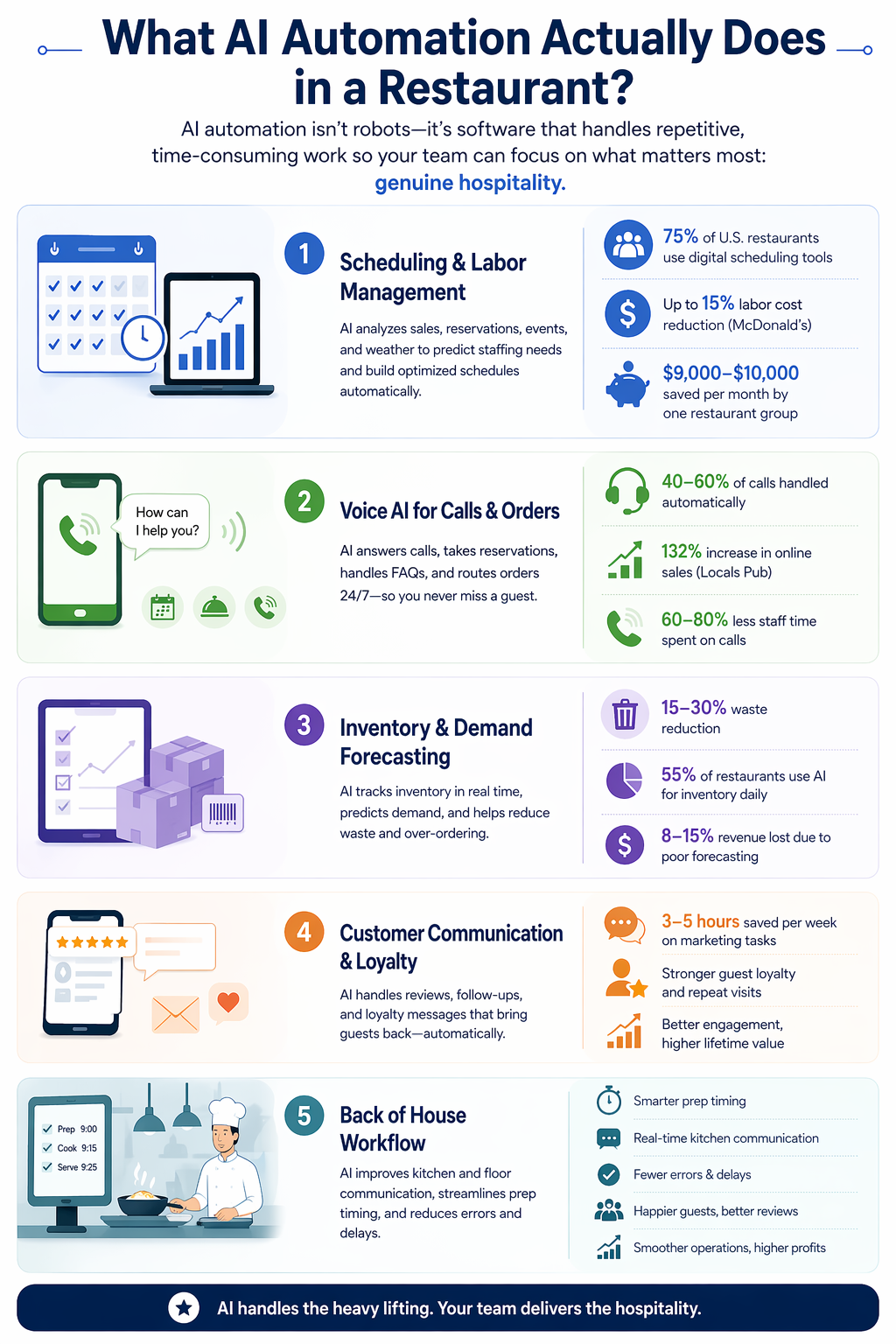
Here’s where it shows up in real operations:
Scheduling & Labor Management: AI scheduling tools analyze historical sales data, upcoming reservations, local events, and even weather forecasts to predict staffing needs with precision. They build optimized schedules automatically.
- 75% of U.S. restaurants now rely on digital scheduling tools, up from a fraction just three years ago
- McDonald’s integrated AI scheduling across U.S. franchises, syncing with POS systems to adjust staffing in real time; trimming labor costs by up to 15%
- One restaurant group reported saving $9,000–$10,000 per month simply by switching to AI-driven scheduling templates.
No more managers burning three hours every Sunday night trying to piece together who’s available Friday.
Voice AI for Calls & Orders: Voice AI answers your phone, takes reservations, handles FAQs, and routes orders, 24 hours a day, without a human picking up.
- Restaurants using AI phone systems report 40–60% of phone interactions handled automatically.
- AI phone systems reduce staff time spent on calls by 60–80%, freeing your team to focus on in-room guests.
- Locals Pub saw online sales surge 132% within 90 days of implementing automated phone answering.ng
- Dine Brands (Applebee’s and IHOP’s parent company) is already testing Voice AI agents to handle phone orders at scale, citing labor shortages as the core driver.
The math is simple: fewer missed calls = more reservations captured = more revenue retained.
Inventory & Demand Forecasting: AI tracks inventory in real time, flags waste before it happens, and triggers reorders based on projected demand.
- Restaurants lose 8–15% of revenue due to poor demand forecasting, food waste, and disconnected ordering systems
- AI-powered inventory management delivers 15–30% waste reduction in documented implementations
- 55% of restaurants already use AI for inventory management daily, with another 25% currently in pilot testing (Deloitte, 2025)
Less guesswork. Less over-ordering. Better margins.
Customer Communication & Loyalty: Automated review monitoring, follow-up messages, and loyalty triggers handle the consistent touchpoints that build repeat visits, the ones that are too time-consuming for a stretched team to manage manually. Restaurants using AI for marketing automation save owners 3–5 hours per week on content creation and campaign management alone.
Back of House Workflow: From prep timing to kitchen to floor communication, AI tools reduce the friction that leads to delays, comps, and frustrated guests. When the kitchen runs cleaner, your entire operation runs cleaner.
The Real Numbers: What Operators Are Actually Seeing
Skeptical? The data is in.
 restaurant AI automation
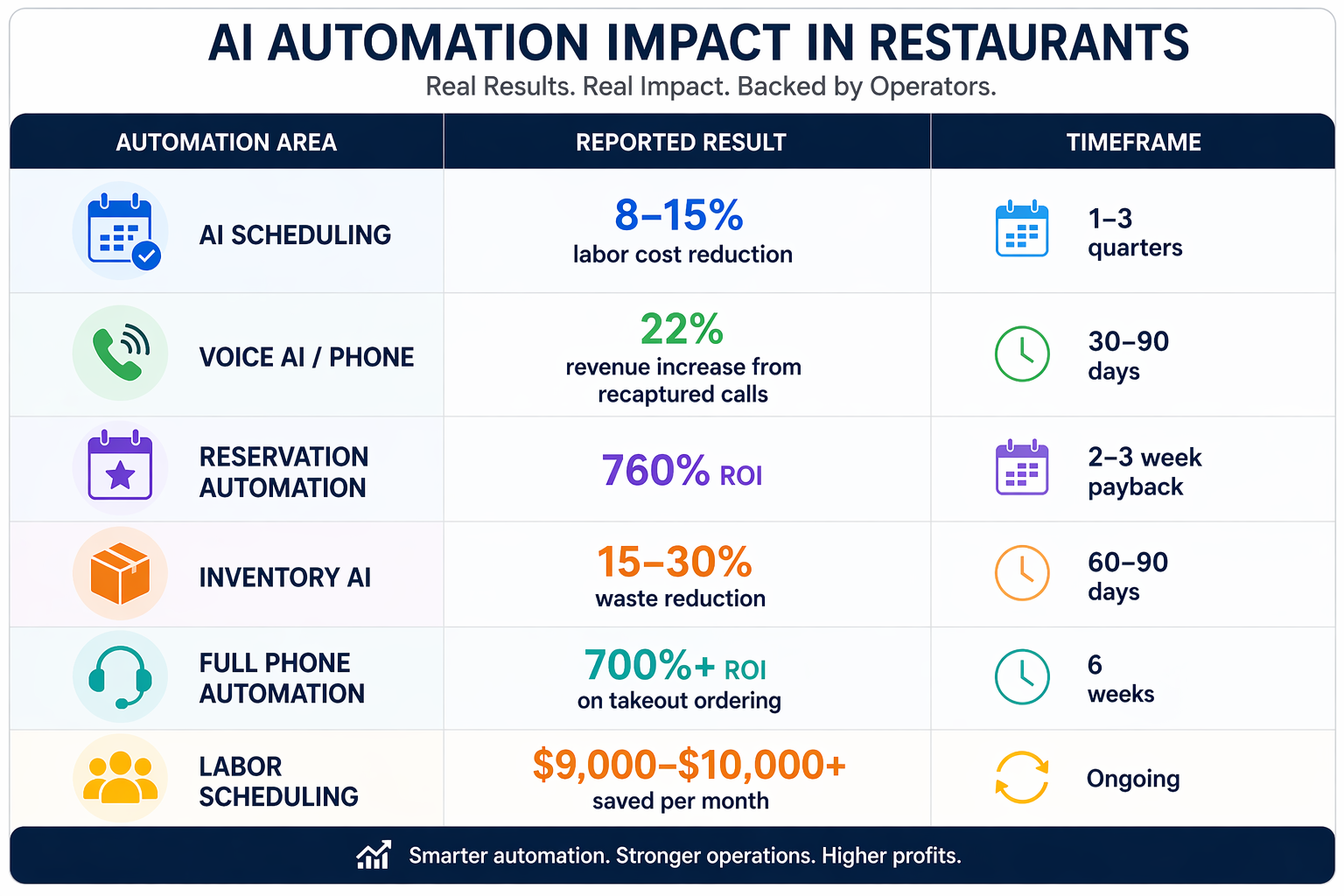
The honest caveat: ROI isn’t instant, and it isn’t magic. Most operators see immediate time savings and workflow improvements in the first month. Meaningful financial impact recovered margins, lower waste, stabilized labor percentages; builds over one to three quarters as the system learns your operation.
The operators who quit after 30 days rarely see a return. The ones who stay the course almost always do.
As of 2026, 26% of restaurant operators are already using AI tools, with the vast majority planning to expand usage. The early movers are building a compounding operational advantage that will be increasingly difficult to close.
For Franchisees & Multi-Unit Operators: Where AI Really Multiplies
If you operate more than one location, restaurant automation doesn’t just help; it scales in ways that manual processes simply cannot replicate.
The core promise of any franchise is consistency. Guests should have the same experience at your Dallas location as they do in Denver. That’s nearly impossible to guarantee when every location manager runs their own scheduling process, reviews inconsistently, and manages inventory differently.
AI changes that equation entirely.
Flynn Group, the world’s largest restaurant franchise operator, with 2,900+ locations and over $5 billion in annual revenue, is already using AI to power personalized digital menus and mobile app experiences at scale. They’re not experimenting. They’re executing.
For a franchisee operating five to twenty locations, the same opportunity applies:
- Unified scheduling across all locations, locally optimized but consistently structured
- Centralized review monitoring no more manually checking Google for every location every day
- Real-time labor and inventory visibility across all locations from a single dashboard
- Brand consistent customer communication that doesn’t vary by which manager is on shift
The multi-unit ROI case is often stronger than a single location case because the fixed cost of the system spreads across more revenue. You’re also building operational infrastructure that makes each new location faster and cheaper to launch.
“But Won’t This Replace My Staff?” The Honest Answer
This comes up in almost every conversation about restaurant automation. It deserves a direct answer.
A National Restaurant Association survey found that 20% of restaurant employees feel uneasy about AI-generated scheduling, fearing they’ll lose personal input into their hours. If you roll out automation without explaining what it’s for and what it isn’t, you’ll create friction with the team you’re trying to support.
Here’s what the data actually shows: the restaurants using AI most effectively are not cutting headcount. They’re using it to stop losing good people.
Turnover in the restaurant industry is largely driven by chaotic schedules, last-minute changes, and a general sense that management doesn’t have a handle on things. When AI gives your team more predictable hours, fairer shift distribution, and fewer last-minute scrambles, they tend to stay longer.
In Toast’s 2025 operator survey, 86% of restaurant operators said they’re comfortable using AI, and 81% expect to use more of it. The industry has crossed the threshold from skepticism to adoption.
AI handles the administrative. Your team handles the human. One manager at a mid-sized restaurant group put it plainly: her team stopped dreading Sunday nights once scheduling became a system everyone could trust.
That’s not replacing people. That’s making their jobs worth keeping.
A Practical 4 Step Playbook: How to Automate Without Getting Overwhelmed
Most articles on this topic paint a great picture and then leave you staring at a long tool list with no idea what to do next. Here’s a framework that actually works in practice.
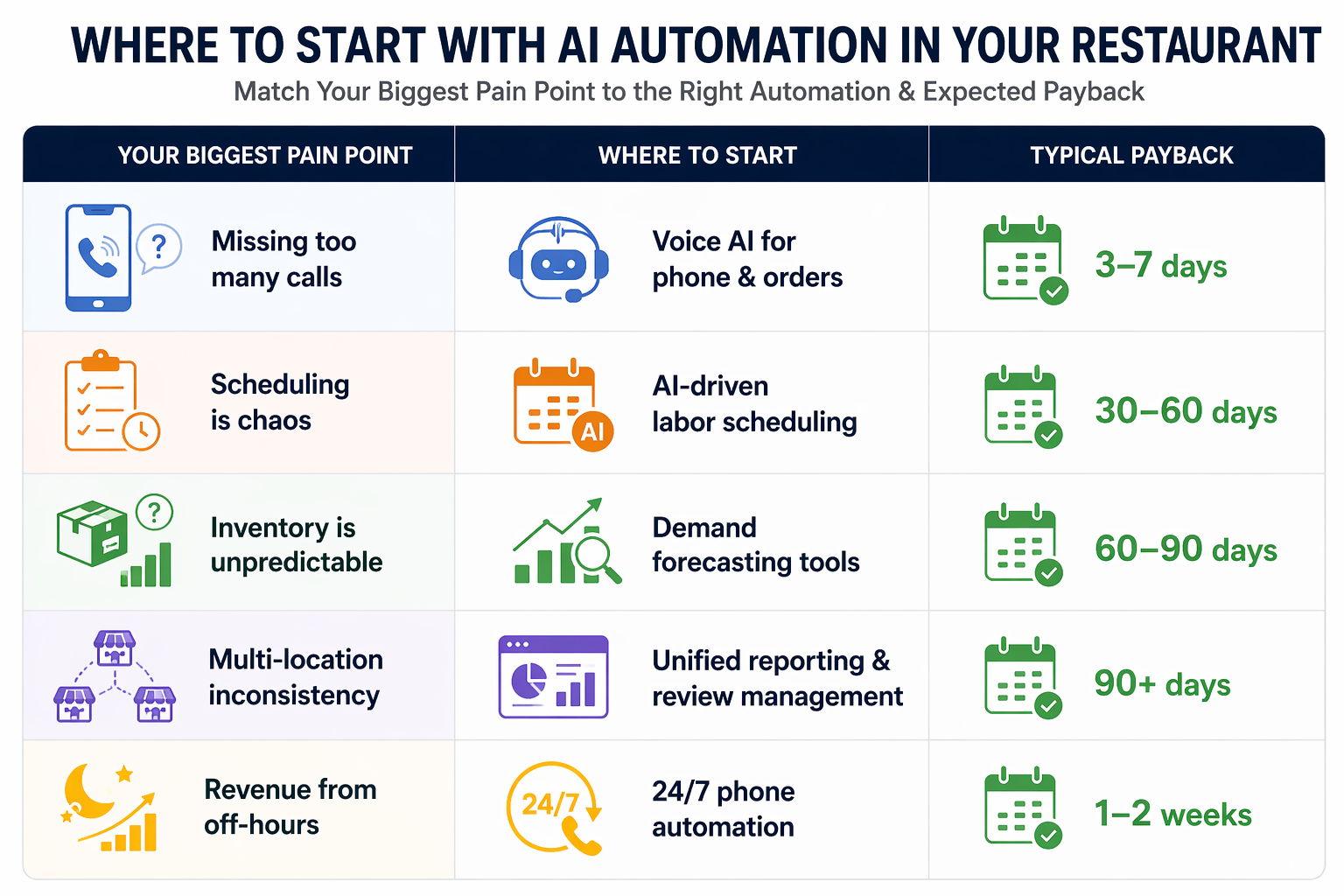
Step 1: Name Your #1 Operational Pain Point: Don’t start with “AI” as a concept. Start with your specific problem. Is it scheduling chaos? Missed calls? Food waste? Inconsistency across locations? Pick one.
Step 2: Pilot One Tool for 90 Days: Find a solution built specifically for that problem. Implement it at one location, or for one use case. Give it a genuine runway; 90 days is enough to see a real signal without overcommitting.
Step 3: Measure Against a Clear Baseline: Before you start, document your current state:
- Hours managers spend on scheduling per week
- Calls missed per day (or per peak period)
- Labor percentage per location
- Weekly food waste value
Compare honestly at the 30, 60, and 90-day marks. The data will tell you what to do next.
Step 4: Expand to the Next Bottleneck: Once you have proof of concept in your operation, with your numbers, move to the next friction point. This is how successful operators build: incrementally, with evidence.
What to Look for in an Automation Partner?
The restaurant tech vendor landscape has gotten crowded fast. Not all AI tools are created equal. Here are the questions worth asking before you commit:
Do they understand restaurants, not just software? Generic automation platforms can be adapted, but restaurant operations have specific rhythms, peak hours, seasonal swings, and the POS to kitchen handoff that a purpose-built partner will handle far better.
Can they integrate with your existing POS? Any tool that creates a parallel system rather than connecting to your current data creates more work, not less. Ask for a direct integration list before signing anything.
What does onboarding actually look like? A 30-page PDF and a help centre are not implementation support. You want a partner who will configure the system to your specific operation, not hand you software and wish you luck.
Can they show ROI projections before you sign? A credible partner should be able to model what the return looks like based on your current volume, labor costs, and pain points. If they can’t put numbers to it, that’s worth noting.
The restaurants pulling ahead on automation aren’t necessarily bigger or better funded. They’re the ones who stopped waiting for the “right time” and started with one problem.
With 26% of operators already using AI and the global restaurant scheduling software market projected to reach $3.12 billion by 2035, the question isn’t whether automation is coming to restaurants. It’s whether you’ll help shape how it works in yours or react to it after the operators around you already have.
At Aximise, we help restaurant operators build and implement AI solutions that fit how they actually operate, not off-the-shelf tools forced into their workflow. We specialise in custom AI consulting and software development, and help operators go from overwhelmed to running on systems they can trust.
If you’re ready to see what restaurant automation could realistically do for your operation, whether you run one location or twenty, reach out to us. We’ll look at your operation, walk through your biggest pain points, and give you an honest picture of where to start.
FAQs-
- What is restaurant automation?
AI software that handles repetitive tasks, scheduling, phone orders, inventory, and customer communication so your team can focus on hospitality instead of admin. - How much does it cost?
Entry-level tools start around $149/month per location. Full platform implementations range from $40K to $400K+. Most operators start small and scale once ROI is proven. - How long until I see ROI?
Voice AI and reservation tools often pay back within days to 6 weeks. Scheduling and inventory tools typically show measurable returns within one to three quarters. - Can small restaurants benefit?
Absolutely. Voice AI for missed calls and AI scheduling are the highest impact starting points for fast returns, with no large upfront investment required. - How do multi-location operators use it?
Centralized scheduling, review monitoring, and real-time labor and inventory visibility across all locations from one dashboard, consistent brand standards, and local flexibility. - Will it upset my staff?
Only if you don’t communicate. Explain the goal upfront, and more predictable, fairer schedules, and most teams come around quickly once they see it in action. - What’s the biggest mistake operators make?
Doing too much at once. Pilot one tool, prove it, then scale. The operators who try to overhaul everything at once rarely stick with it long enough to see results.