
An insurance claim can start with a single click, but what happens after that is rarely that simple.
A claim may pass through forms, emails, policy documents, photographs, invoices, damage assessments, fraud checks, and multiple rounds of human review before it reaches a decision. For insurers handling thousands of claims, these repetitive steps can quickly become a bottleneck.
This is where AI is changing the game.
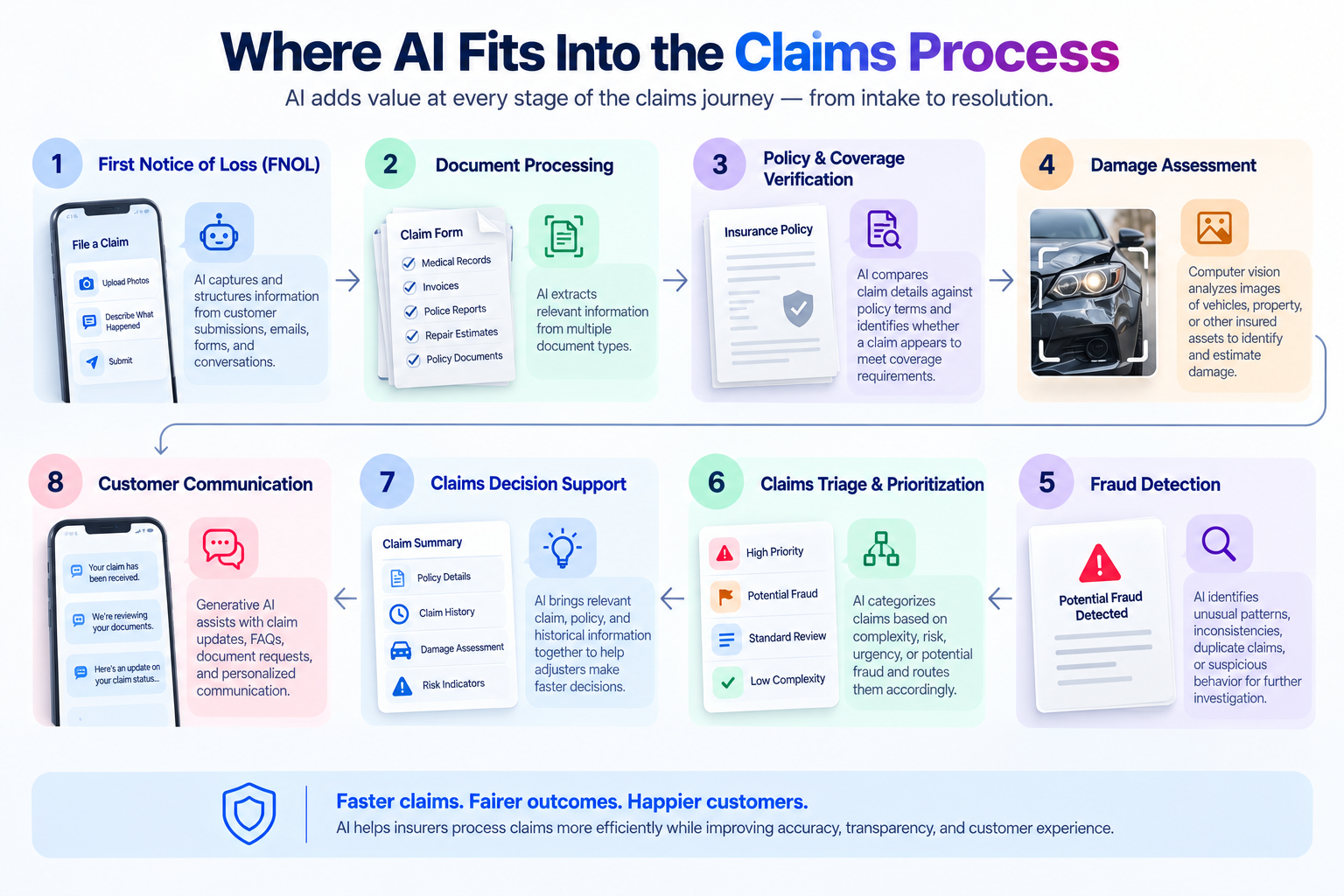
From extracting information from documents and assessing damage in images to flagging suspicious claims and helping adjusters prioritize cases, AI can automate large parts of the claims journey without removing humans from the process.
The result? Faster processing, fewer manual errors, and claims teams that can spend less time moving information around and more time making decisions that actually require human judgment.
So, how exactly is AI automating insurance claims processing—and where does it make the biggest difference?
What Is AI-Powered Insurance Claims Processing?
AI-powered insurance claims processing uses artificial intelligence to automate and assist with tasks across the claims lifecycle—from claim submission to settlement.
Instead of manually reviewing forms, extracting data, checking policies, assessing damage, and screening for fraud, AI can handle many of these repetitive tasks. It can extract information from documents, analyze damage images, identify unusual claim patterns, and route complex cases to the right adjuster.
The goal isn’t to eliminate human involvement. It’s to let AI handle routine work while claims professionals focus on complex cases, investigation, and decisions that require human judgment. Key technologies include:
- Machine Learning for risk assessment and fraud detection
- NLP for understanding claims-related text
- Computer Vision for damage assessment
- Generative AI for summaries and customer communication
- Intelligent Document Processing for extracting claims data
Benefits of AI Claims Automation
AI claims automation does more than reduce manual work. It can help insurers process claims faster, improve accuracy, and give claims teams more time to focus on decisions that require human expertise.
- Faster Claims Processing: AI can automate data extraction, document review, and initial claim assessment, reducing processing time and helping straightforward claims move faster.
- Lower Operational Costs: By handling repetitive administrative tasks, AI reduces the amount of manual effort required for high-volume claims.
- Better Fraud Detection: AI can analyze large volumes of claims data to identify unusual patterns, inconsistencies, or behaviors that may indicate potential fraud.
- Fewer Manual Errors: Automated data extraction and validation can reduce errors caused by manual data entry and repetitive processing.
- Better Customer Experience: Faster processing, timely updates, and quicker responses can make the claims experience smoother for policyholders.
- More Efficient Claims Teams: Instead of spending hours on routine tasks, adjusters can focus on complex claims, investigations, and decisions that require human judgment.
AI Claims Automation vs. Traditional Claims Processing
Traditional claims processing often relies heavily on manual work. Claims teams may need to enter data, review documents, verify policy details, assess damage, check for fraud, and communicate with customers across multiple systems. As claim volumes grow, these repetitive steps can slow down processing and increase the chances of errors.
AI claims automation changes this workflow by taking over many of these routine tasks. AI can extract and organize claims data, analyze documents and images, identify potential fraud, prioritize claims, and provide adjusters with relevant information. This allows straightforward claims to move faster while complex cases receive more focused human attention.
The biggest difference isn’t humans vs. AI. It’s manual processing vs. intelligent assistance. Traditional workflows depend on people to manage much of the process, while AI-powered workflows use automation to handle repetitive work and support faster, more informed decisions.
Challenges of Using AI in Insurance Claims
AI can make claims processing faster and more efficient, but implementing it isn’t as simple as adding an AI tool to an existing workflow. Insurers also need to consider data, technology, compliance, and human oversight.
- Data Quality and Availability: AI relies on accurate, well-structured data. Incomplete, inconsistent, or siloed claims data can affect the quality of AI-driven decisions.
- Legacy System Integration: Many insurers still operate on older systems that weren’t designed to work with modern AI solutions. Connecting AI with these systems can require careful integration.
- Privacy and Security: Insurance claims often contain sensitive personal, financial, and medical information. Strong data protection and access controls are essential when using AI.
- Bias and Explainability: AI decisions need to be fair and understandable, especially when they influence claim approvals, payouts, or fraud investigations.
- Human Oversight: Not every claim should be fully automated. Complex, high-value, or disputed claims may still require experienced professionals to review the situation and make the final decision.
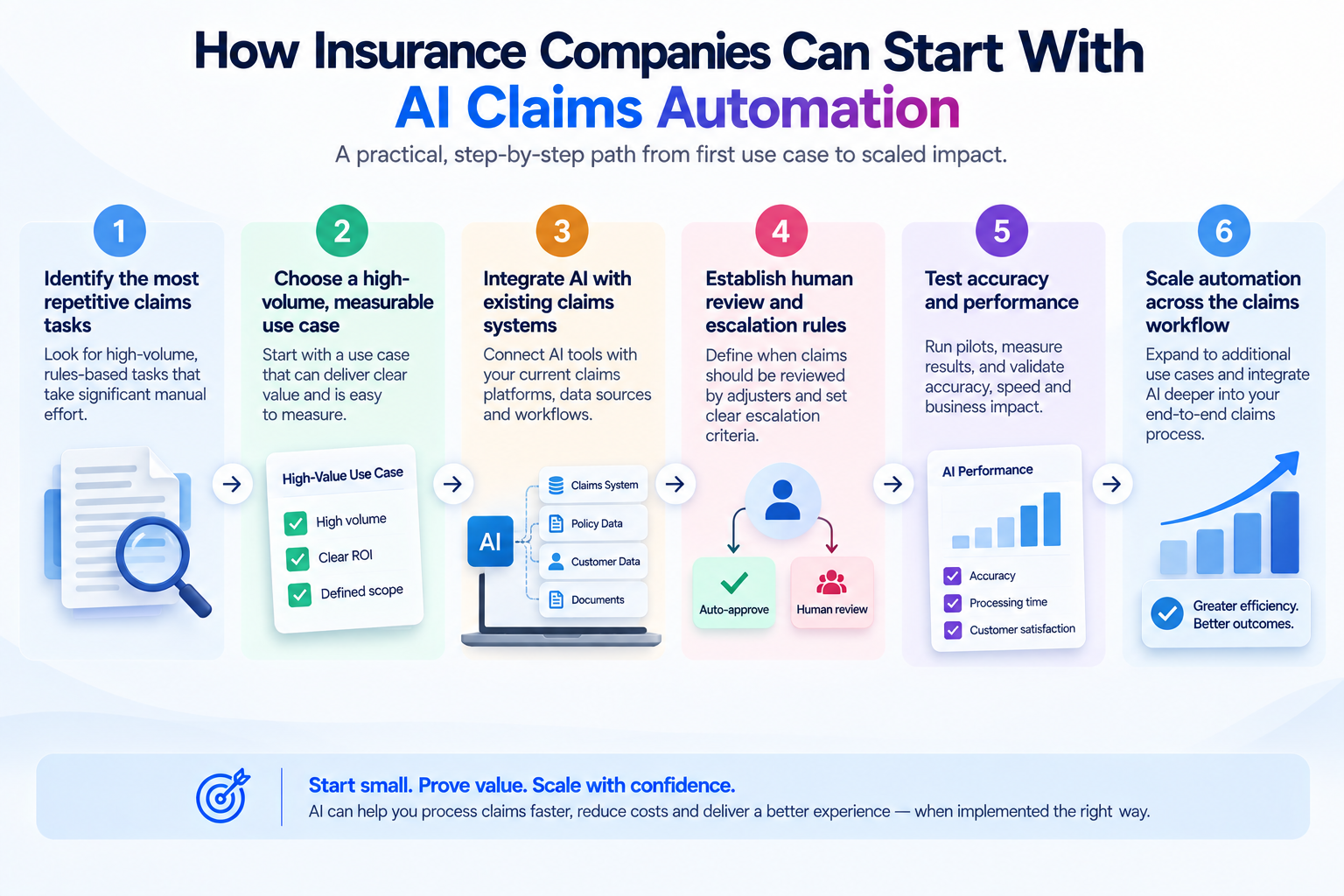
The key is to treat AI as an augmentation layer for claims teams, with the right controls and human oversight built into the workflow.
The Future of AI in Insurance Claims
- Straight-through processing: More simple claims could be assessed and settled with minimal human intervention.
- Real-time damage assessment: AI-powered computer vision can speed up the assessment of vehicle, property, and other asset damage.
- Smarter fraud detection: AI will identify suspicious patterns across larger and more complex datasets.
- AI-powered claims assistants: Adjusters and customers can get instant access to claim information, summaries, and next steps.
- Multimodal AI: AI will combine text, images, documents, and structured data to build a more complete view of each claim.
- More personalized experiences: Faster decisions and proactive communication can make the claims journey smoother for policyholders.
AI is changing insurance claims from a largely manual process into a faster, more intelligent workflow. From automating document processing and assessing damage to detecting fraud and supporting adjusters, AI can help insurers improve efficiency without taking human judgment out of the equation. The real opportunity lies in identifying the right parts of the claims journey to automate and integrating AI into existing systems in a way that is secure, scalable, and practical.
Looking to explore how AI can improve your insurance claims process?
Aximise can help you identify the right use cases, build AI-powered solutions, and integrate them into your existing technology ecosystem.