
Your first AI project failed.
Not because AI doesn’t work. Not necessarily because you hired the wrong developers.
It may have failed before development even began.
The wrong problem. Weak data. Unrealistic expectations. No clear ROI. These decisions can turn an AI initiative into an expensive experiment instead of a business win.
Before you hire your next AI consulting partner, fix what went wrong the first time.
The Real Cost of Getting Your First AI Project Wrong
A failed AI project costs more than the money spent building it. The bigger damage is what happens after the project fails: lost time, lower confidence, and hesitation to invest in AI again.
- Wasted Budget: Development costs are only the beginning. Businesses can also lose money on cloud infrastructure, AI tools, integrations, data preparation, and internal resources when a project never reaches meaningful adoption.
- Lost Time and Productivity: Months can go into building, testing, and refining an AI solution that doesn’t solve the right problem. Teams spend valuable time supporting a project that should have been validated before development started.
- Loss of Employee and Customer Trust: An AI tool that produces inconsistent results or doesn’t fit existing workflows quickly loses users. Once employees stop trusting the system, getting them to adopt the next AI initiative becomes much harder.
- Delayed Business Outcomes: While a failed project consumes resources, other high-value opportunities remain untouched. Competitors may already be automating processes, improving customer experiences, or using AI to make faster decisions.
- AI Fatigue at the Leadership Level: Perhaps the biggest cost is internal skepticism. A failed first project can turn “Let’s see what AI can do” into “We tried AI. It didn’t work.”
And that’s why the goal shouldn’t be to build an AI project quickly. It should be to identify the right problem, validate the opportunity, and build something that has a clear path to business value.
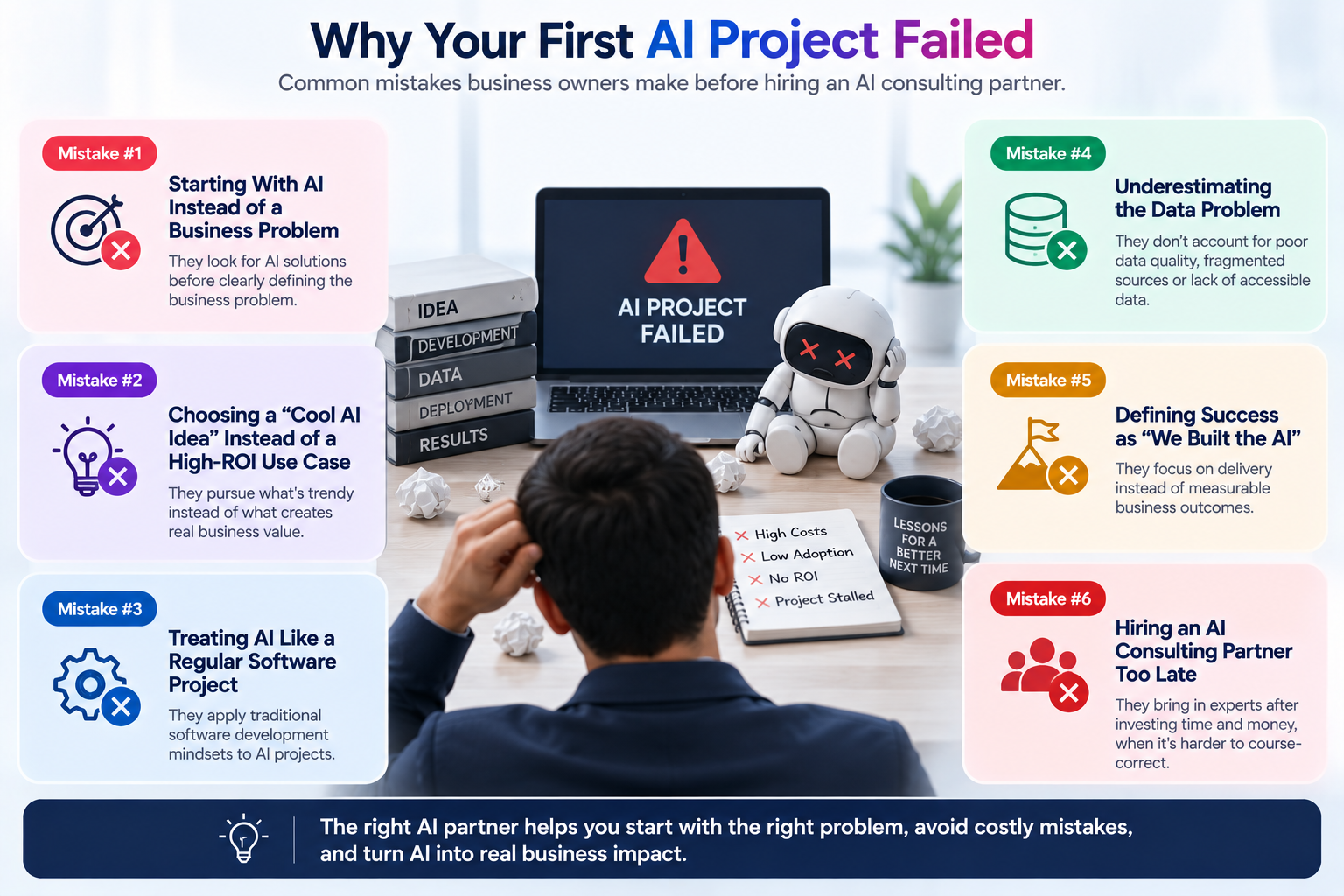
Mistake #1: Starting With AI Instead of a Business Problem
One of the easiest ways to waste money on AI is to start with the technology.
Businesses ask, “Where can we use AI?” when the better question is, “What business problem is costing us the most?” That difference matters. AI isn’t automatically the right answer just because a process is repetitive or because competitors are using it.
For example, a company might automate a process that employees complete quickly and rarely struggle with. Another might build a chatbot when customers don’t actually need a chatbot—they need faster access to accurate information. A product team might add an AI feature because it sounds innovative, even though customers never asked for it.
Generative AI can make this problem worse. With so many new AI capabilities available, it’s tempting to build something simply because everyone else is doing it. The better approach is simple: start with the problem, not the technology.
Identify the biggest operational bottleneck, customer pain point, revenue opportunity, or productivity gap. Then evaluate whether AI can solve it better, faster, or more cost-effectively than existing alternatives.
The goal isn’t to find somewhere to put AI. It’s to find where AI can create measurable business value.
Mistake #2: Choosing a “Cool AI Idea” Instead of a High-ROI Use Case
Not every AI idea deserves a development budget.
An idea can sound impressive in a boardroom and still have little impact on the business. The challenge is separating interesting AI possibilities from valuable AI opportunities. Before investing in a use case, businesses should evaluate it across a few critical dimensions:
- Business impact: How significant is the problem being solved?
- Implementation complexity: How difficult and expensive will it be to build?
- Data availability: Does the business have the data required to make it work?
- Expected ROI: What financial or operational return can realistically be expected?
- Adoption potential: Will employees or customers actually use it?
- Time to value: How quickly can the business start seeing results?
This is where an AI use-case prioritization framework becomes valuable. Instead of choosing projects based on hype, rank potential use cases based on their business value, feasibility, risk, and speed to impact.
For example, automating a high-volume manual workflow that consumes hundreds of employee hours may deliver far more value than adding an AI-generated feature to a product simply because it looks innovative. The best AI project isn’t necessarily the most advanced one. It’s the one that solves an important problem and produces measurable results.
Mistake #3: Treating AI Like a Regular Software Project
A traditional software project generally follows a predictable path: define requirements, build the system, test it, and deploy it. AI doesn’t always work that way.
AI systems introduce variables that traditional applications don’t have. Outputs may not always be deterministic. Model performance can change depending on the quality and context of the data. A model that performs well in testing may behave differently when exposed to real-world users and edge cases.
And accuracy alone doesn’t determine whether an AI project is successful.
An AI solution could be technically accurate but too slow for employees to use. It could generate good responses but fail to integrate into existing workflows. It could work perfectly in a controlled environment but become too expensive to operate at scale. That’s why AI projects need:
- Continuous testing and evaluation
- Model and performance monitoring
- Real-world user feedback
- Iterative improvements
- Cost and infrastructure management
- Ongoing optimization
The mindset needs to shift from “build and launch” to “build, measure, learn, and improve.” A technically complete AI product isn’t necessarily a successful business product. The real test is whether it performs reliably in the environment where the business actually needs it.
Mistake #4: Underestimating the Data Problem
Here’s an uncomfortable truth: your AI project can only be as ready as your data.
Businesses often assume that once they choose a model or AI platform, development can begin. But the real work may be hidden inside the company’s existing data. Information may be spread across CRMs, ERPs, spreadsheets, databases, cloud platforms, emails, and legacy systems. Some data may be incomplete, outdated, duplicated, poorly structured, or inaccessible.
Common challenges include:
- Poor-quality or inconsistent data
- Scattered data sources
- Insufficient historical data
- Incompatible formats
- Data silos between departments
- Unclear data ownership
- Privacy and security constraints
Ignoring these issues can lead to unreliable AI outputs, longer development timelines, higher costs, and disappointing results.
That’s why data readiness should be assessed before the AI solution is designed. A good AI consulting partner should examine what data exists, where it lives, how reliable it is, who can access it, and whether it can support the intended use case.
Sometimes the right first step isn’t building the AI at all. It may be getting the business’s data ready for AI.
Mistake #5: Defining Success as “We Built the AI”
One of the most dangerous ways to measure an AI project is by what gets delivered.
The team trained the model.
The MVP launched.
The AI was integrated into the product.
The dashboard is live.
Great.
But did the business actually improve?
A successful AI project shouldn’t be measured only by technical milestones. It should be connected to business outcomes such as:
- Hours of manual work eliminated
- Operating costs reduced
- Faster decision-making
- Higher conversion rates
- Lower customer support volume
- Increased revenue
- Improved employee productivity
For example, an AI customer-support system isn’t successful because it generates responses. It’s successful if it helps resolve issues faster, reduces support workload, maintains quality, and improves the customer experience. Before development starts, define what success will look like—and attach it to measurable business KPIs.
Instead of asking: “Did we build it?”
Ask: “Did it improve the business?”
That shift can completely change how an AI project is planned, funded, and evaluated.
Mistake #6: Hiring an AI Consulting Partner Too Late
Some businesses bring in an AI consulting partner only after the major decisions have already been made.
The technology has been chosen. The infrastructure has been purchased. The model has been selected. The solution has already been defined. Development may have already started.
At that point, the consultant is often being asked to execute a decision rather than help make the right one.
That’s backwards.
The right AI consulting partner should be involved before development begins; when there is still room to challenge assumptions, identify risks, and change direction without wasting significant resources.
Early-stage AI consulting should help businesses with:
- Use-case discovery: Identify where AI can create meaningful business value.
- Feasibility assessment: Determine whether the idea is technically and commercially viable.
- AI readiness: Evaluate data, infrastructure, security, and organizational readiness.
- Architecture: Determine how the AI solution should fit into the existing technology ecosystem.
- Data strategy: Identify the data required and how it should be prepared and accessed.
- ROI modeling: Estimate costs, benefits, risks, and potential returns.
- MVP planning: Define the smallest version that can validate the idea before significant investment.
A good consulting partner shouldn’t simply ask, “What do you want us to build?”
They should be willing to ask harder questions: Why are you building it? What problem will it solve? Is AI actually the right solution? What will success look like? And is the business ready to support it?
That’s how you turn AI from an expensive experiment into a business initiative with a clear path to value.
What to Look for in an AI Consulting Partner?
The right AI consulting partner shouldn’t just know how to build AI. They should understand when AI is worth building in the first place. Look for a partner that:
- Starts with your business goals and problems, not a technology stack.
- Validates use cases, feasibility, and ROI before development.
- Understands your data, infrastructure, and existing workflows.
- Can turn an AI idea into a focused MVP and scalable solution.
- Defines success through measurable business outcomes, not just technical milestones.
- Stays involved beyond launch to monitor, optimize, and scale the solution.
Most importantly, choose a partner willing to challenge your assumptions—not one that simply says yes to every AI idea. You don’t need someone who can build anything. You need someone who knows what is worth building.
Your first AI project doesn’t have to become your most expensive lesson. Most AI failures aren’t caused by a lack of technology. They’re often caused by choosing the wrong problem, overlooking data challenges, chasing AI trends, or starting development before the business case is clear.
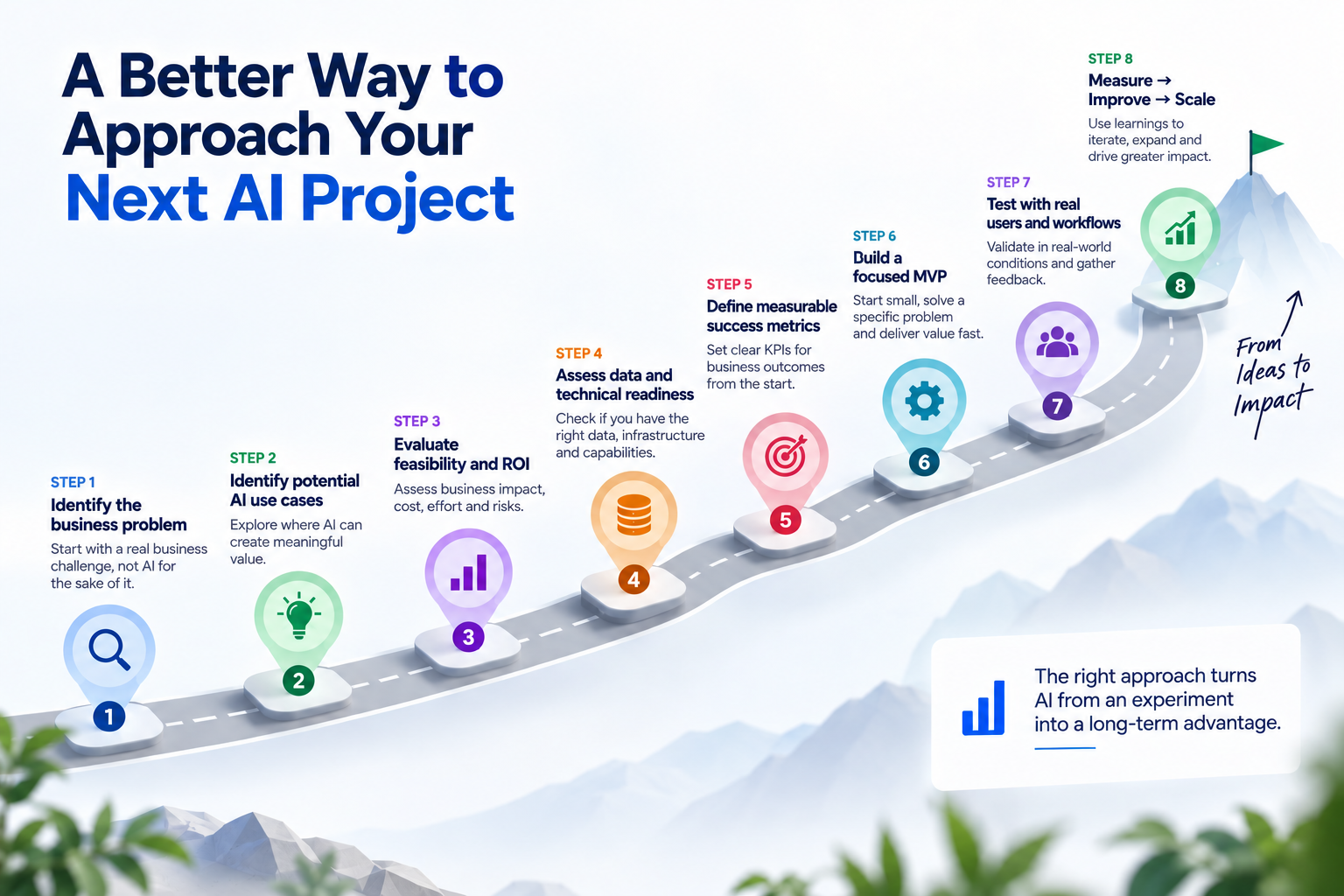
The smarter approach is to get the strategy right first.
Identify the right opportunity. Validate the use case. Assess feasibility and data readiness. Define ROI. Then build an MVP that can prove its value before you scale.
Planning your next AI project? Start with the strategy—not the code.
Aximise helps businesses identify high-value AI opportunities, validate ideas, build focused MVPs, and develop scalable AI solutions aligned with real business outcomes. Talk to Aximise and turn your next AI idea into a project worth building.