

A Tropical Smoothie Cafe can look busy, successful, and packed with customers, but behind the counter, many franchise owners are dealing with rising labor costs, staffing issues, inventory waste, delivery pressure, and shrinking profit margins.
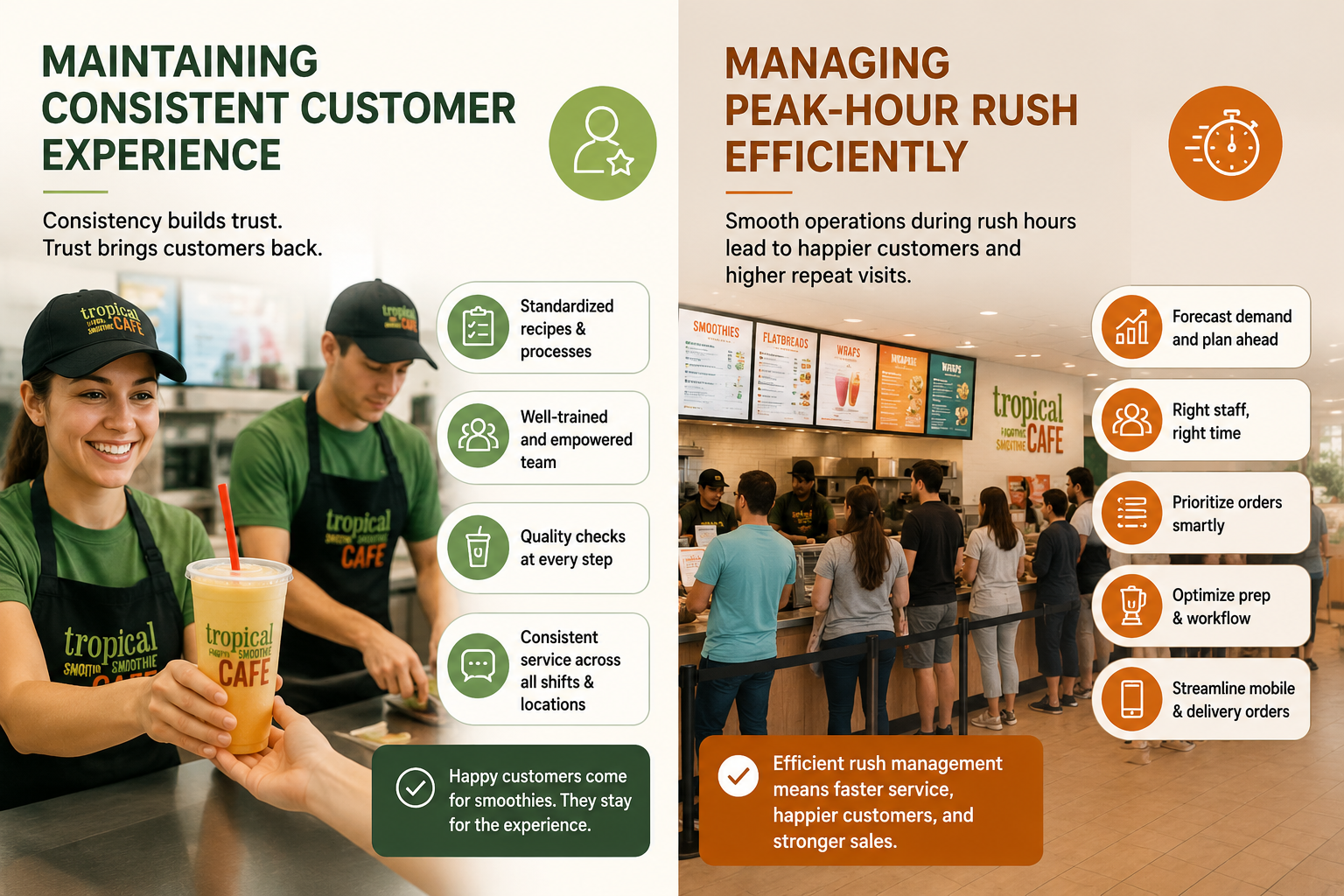
The reality is, running a smoothie cafe today is no longer just about serving great products. It’s about managing operations efficiently while keeping customer experience consistent during every rush hour.
The good news? Most of these challenges are solvable with smarter systems, better forecasting, and automation.
Rising Labor Costs and Staffing Shortages
Labor remains one of the biggest operational challenges for restaurant and smoothie cafe owners. Finding reliable staff is becoming harder, employee turnover is increasing, and managers often end up covering shifts themselves during busy hours.
For cafe owners, this directly affects customer experience, service speed, and overall profitability. Rush hours can quickly become overwhelming when stores are understaffed. Long wait times, delayed mobile orders, exhausted employees, and inconsistent service often lead to negative customer experiences and lower repeat visits.
The solution is not always hiring more people; it’s managing labor more efficiently.
Modern restaurant technology and AI-powered tools can help owners optimize staffing without increasing unnecessary labor costs. Smart ways to improve labor efficiency:
- AI-based shift forecasting based on sales trends
- Smart scheduling tools to avoid overstaffing or understaffing
- Cross-training employees for operational flexibility
- Automated workflows that reduce repetitive manual tasks
- Real-time labor performance tracking
Reducing unnecessary labor hours starts with better operational visibility.
Inventory Waste and Food Cost Management
Inventory management is one of the most overlooked profit killers in smoothie and beverage businesses. Cafe locations depend heavily on fresh fruits, vegetables, dairy products, and other perishable ingredients, which means even small inventory mistakes can lead to significant losses over time.
Overstocking can increase spoilage and waste, while understocking can lead to missed sales opportunities and unhappy customers. Portion inconsistencies during busy hours also make food costs harder to control.
The biggest issue is that many cafe owners still rely on manual inventory tracking, which leaves room for errors and delayed decision-making. Smarter inventory systems can help operators reduce waste, improve forecasting, and maintain healthier profit margins. Ways to improve inventory and food cost control:
- Real-time inventory tracking across locations
- AI-powered demand forecasting based on sales patterns
- Smart purchasing recommendations
- Automated low-stock alerts
- Better portion control and usage monitoring
In smoothie businesses, reducing even small daily waste can significantly impact long-term profitability.
Balancing Third-Party Delivery Apps with Profitability
Third-party delivery platforms like Uber Eats and DoorDash have become essential for many smoothie and QSR businesses. They help increase visibility and bring in more orders, especially during peak hours.
But for Tropical Smoothie Cafe owners, heavy dependence on these platforms also creates profitability challenges. High commission fees can significantly reduce already tight restaurant margins. On top of that, delayed deliveries, incorrect orders, or poor delivery experiences often impact the cafe’s reputation, even when the issue is outside the store’s control.
The goal should not be to completely avoid delivery platforms, but to create a better balance between third-party orders and direct customer engagement. Smarter ways to improve delivery profitability:
- Encourage direct ordering through the website or app offers
- Build loyalty programs that reward repeat customers
- Use integrated POS systems to manage all orders centrally
- Improve delivery routing and kitchen coordination
- Track delivery performance and peak order timings
The more control cafe owners have over customer relationships and operations, the easier it becomes to protect margins while still benefiting from delivery demand.
Multi-Location Operational Visibility
Managing one cafe is challenging enough; managing multiple locations brings an entirely different level of operational complexity. Tropical Smoothie Cafe owners struggle to maintain consistency, monitor performance, and identify operational issues across stores in real time.
Without centralized visibility, managers often rely on delayed reports, manual updates, or disconnected systems to understand what’s happening at each location. This makes it harder to spot inefficiencies before they affect profitability.
The biggest problem is that decisions are often reactive instead of proactive. Modern restaurant technology can give franchise owners complete operational visibility from a single platform, helping them make faster and smarter decisions.
Solutions that improve multi-location management:
- Unified dashboard systems for all locations
- Real-time sales, labor, and inventory tracking
- Automated operational alerts for unusual activity
- AI-generated performance insights and trend analysis
- Centralized reporting for faster decision-making
When owners can clearly see how every store is performing in real time, it becomes much easier to improve consistency, reduce operational gaps, and scale more efficiently.
Technology Overload and Disconnected Systems
Many cafe owners invest in multiple software tools to improve operations — but instead of simplifying workflows, these systems often create more complexity.
The POS system operates separately from inventory management. Delivery apps don’t sync properly with kitchen workflows. Payroll software sits disconnected from labor scheduling. As a result, managers spend hours manually updating systems, fixing errors, and switching between platforms just to keep operations running smoothly.
The biggest issue is that disconnected systems slow down decision-making and create operational blind spots. Smarter ways to simplify restaurant operations:
- Build a centralized restaurant tech stack
- Use integrated automation systems across departments
- Connect POS, inventory, labor, and delivery platforms
- Create unified operational dashboards for real-time visibility
- Automate repetitive reporting and manual workflows
Too many tools without integration create more work, not less. The right restaurant technology setup should reduce operational friction, not add to it.
Protecting Profit Margins While Scaling
For many cafe owners, increasing sales does not always mean increasing profits. As businesses grow, operational complexity grows with them, and small inefficiencies start becoming expensive at scale.
Higher labor costs, rising ingredient prices, delivery commissions, and inconsistent forecasting can slowly eat into margins without owners realizing it immediately. Many cafes appear busy and successful on the surface, while profitability quietly declines in the background.
The key to protecting margins is making smarter operational decisions based on real-time business data. Strategies that help improve profitability while scaling:
- AI-driven operational analytics for better decision-making
- Menu engineering to focus on high-margin items
- Smart labor-to-sales ratio management
- Predictive business insights based on sales trends
- Automated reporting to identify operational leaks faster
Scaling successfully is not just about selling more; it’s about building systems that help every location operate more efficiently and profitably over time.
How AI and Automation Can Help Cafe Owners?
Managing a cafe today involves much more than serving customers. Owners must handle labor scheduling, inventory, delivery operations, reporting, and customer experience, all while protecting profit margins.
This is where AI and automation can make a major difference.
Instead of relying on manual processes, modern restaurant technology helps operators improve efficiency, reduce waste, and make faster business decisions. How AI helps cafe operations:
- Automates repetitive operational tasks
- Optimizes labor scheduling based on demand
- Improves inventory forecasting and reduces waste
- Tracks customer behavior and sales trends
- Provides real-time operational reporting
Partners like Aximise help QSR brands centralize operations, automate workflows, and improve day-to-day efficiency through smarter restaurant management systems.
The result is better operational control, lower inefficiencies, and a smoother path to scaling profitably.
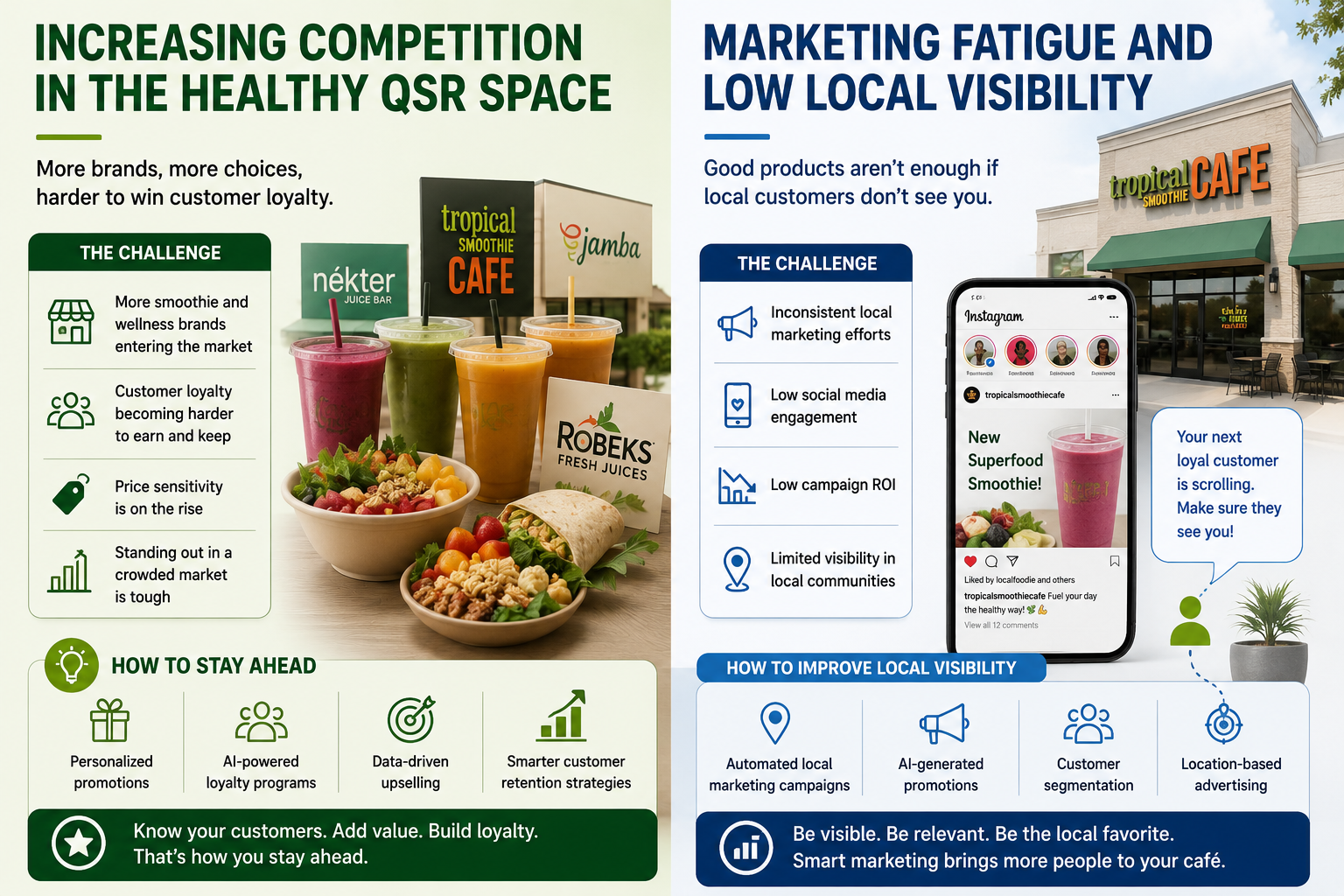
As competition in the restaurant industry continues to grow, operational efficiency is no longer optional; it’s becoming a competitive advantage.
Businesses that embrace automation early will be in a much stronger position to scale sustainably, protect profit margins, and deliver a more consistent customer experience across every location.
If you’re looking to streamline operations and build a smarter, more scalable cafe business, Aximise can help bring operational clarity and efficiency to every part of your restaurant workflow.
____________FAQs__________
- What are the biggest challenges faced by cafe owners?
Some of the biggest cafe franchise challenges include rising labor costs, staffing shortages, inventory waste, delivery app dependency, and maintaining a consistent customer experience across locations.
- How can Tropical Smoothie Cafe owners reduce labor costs?
Cafe owners can reduce restaurant labor costs by using AI-powered scheduling tools, shift forecasting, automated workflows, and smarter labor management systems that improve operational efficiency.
- Why is inventory management important for smoothie cafes?
Smoothie cafes rely heavily on fresh ingredients, making restaurant inventory management critical for reducing food waste, controlling food costs, and protecting profit margins.
- How can AI help improve restaurant operations?
AI for restaurants can help with labor optimization, demand forecasting, inventory tracking, customer analytics, and real-time operational reporting to improve overall cafe efficiency.
- What is the best way to improve profitability in a QSR business?
The best way to improve QSR profitability is by reducing operational inefficiencies, optimizing labor-to-sales ratios, improving forecasting accuracy, and using restaurant automation platforms like Aximise to streamline operations.