

A busy cafe can lose money in ways most customers never notice. A barista stuck updating inventory during peak hours. Two employees are scheduled for a slow afternoon with barely any orders. Long queues are forming because staff are juggling payments, takeaway orders, and table service at the same time. None of these problems comes from “bad staff”; they come from inefficient operations.
At the same time, customer expectations have changed. People expect faster service, shorter wait times, personalized experiences, and seamless ordering, whether they’re grabbing a quick coffee before work or spending hours at a café. For cafe owners, this creates a difficult balancing act: how do you control rising labour costs without making the customer experience feel rushed, understaffed, or impersonal?
The answer is not simply reducing headcount. In fact, many modern cafes are lowering labour costs by working smarter, not harder. From AI-powered scheduling and digital ordering systems to smarter workflows and automation, cafes are finding ways to reduce wasted time, improve efficiency, and keep service quality high, all without sacrificing the experience customers come back for.
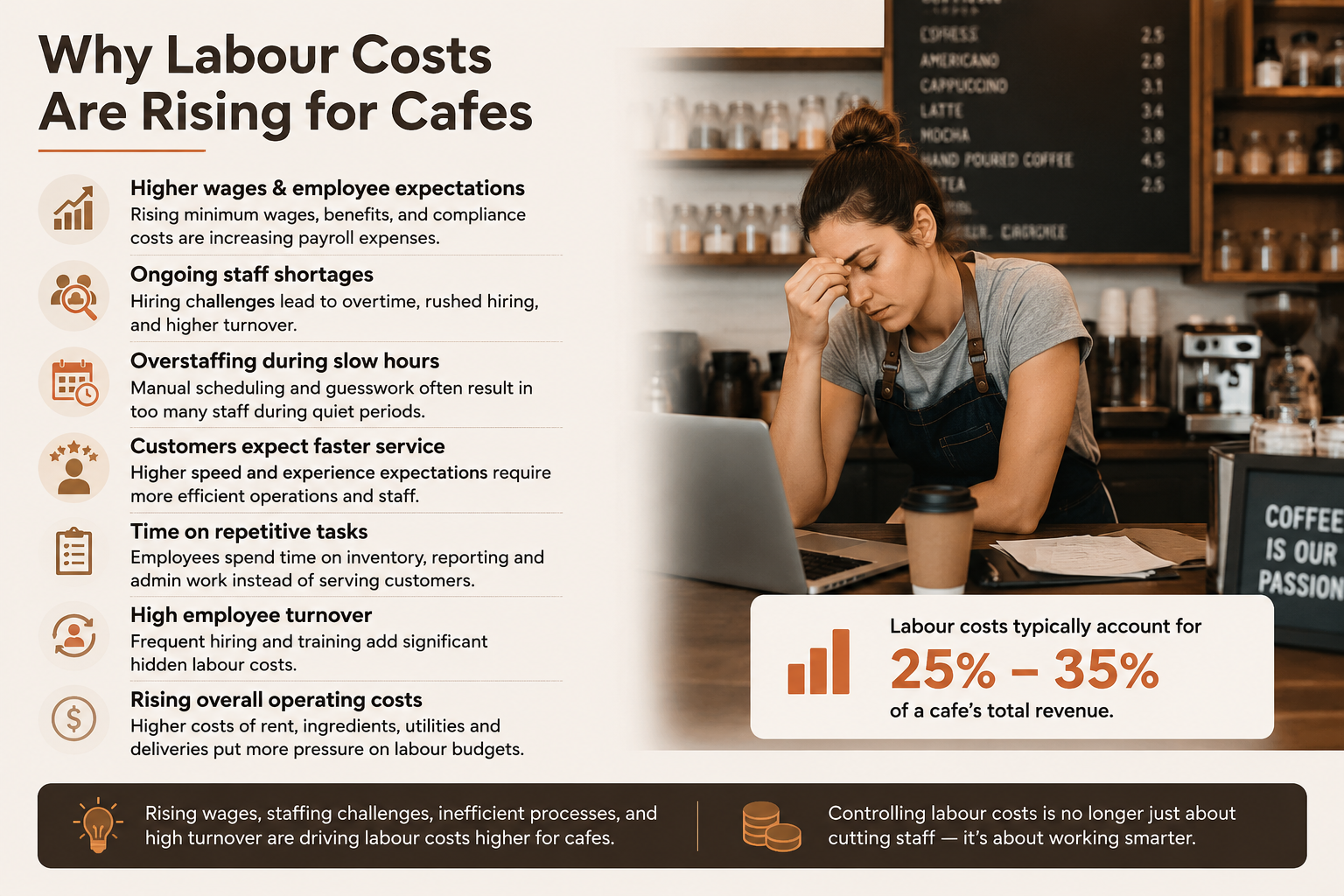
Why Labour Costs Are Rising for Cafes?
Labour has always been one of the biggest operating expenses for cafes, but in recent years, managing staffing costs has become far more difficult. Today, many cafes are dealing with rising wages, staff shortages, changing customer expectations, and increasing operational complexity, all while trying to maintain profitability.
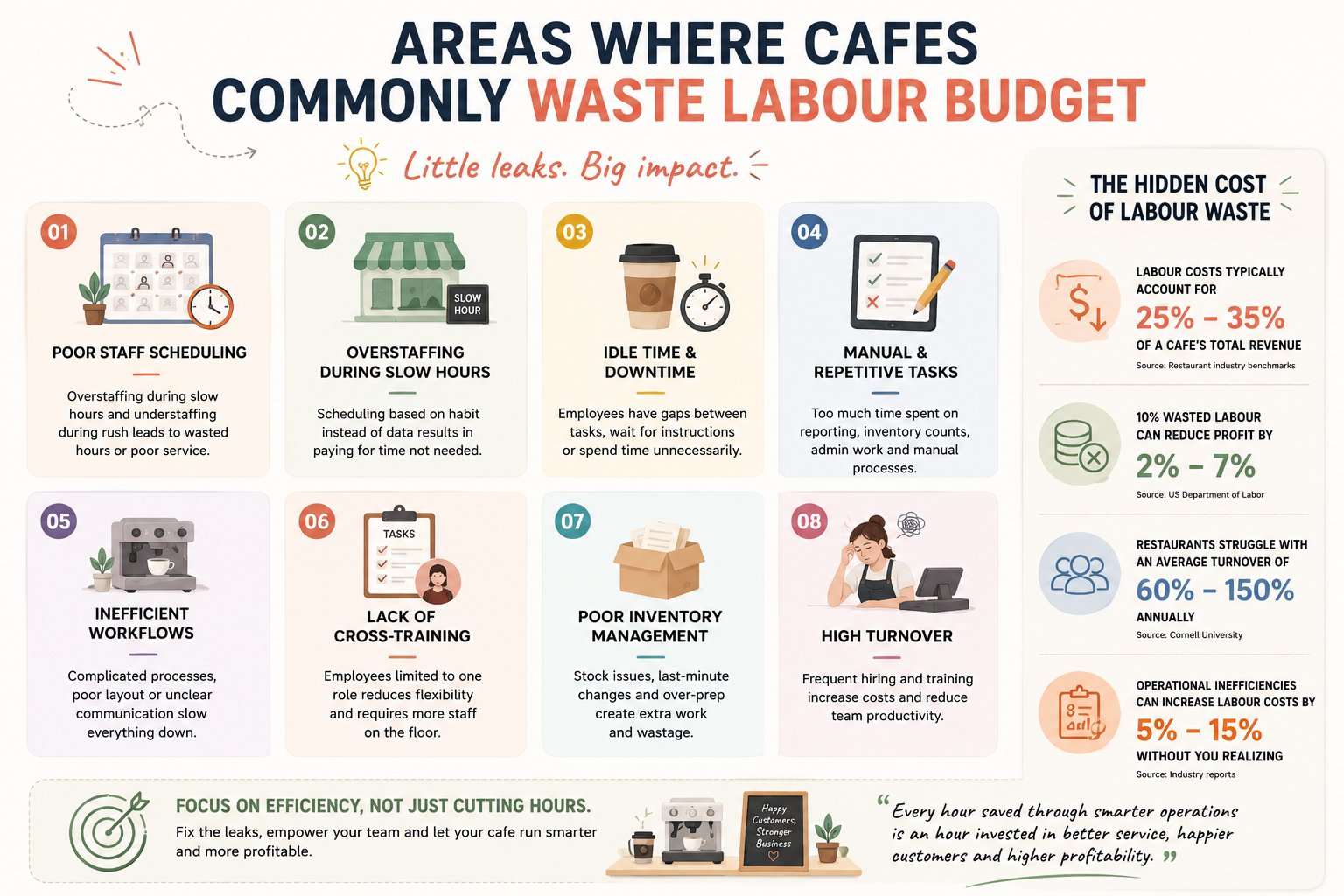
According to restaurant industry benchmarks, labour costs now typically account for nearly 25% to 35% of a restaurant or cafe’s total revenue, with full-service businesses often operating at even higher percentages.
Smart Ways to Reduce Labour Costs Without Affecting Customer Experience
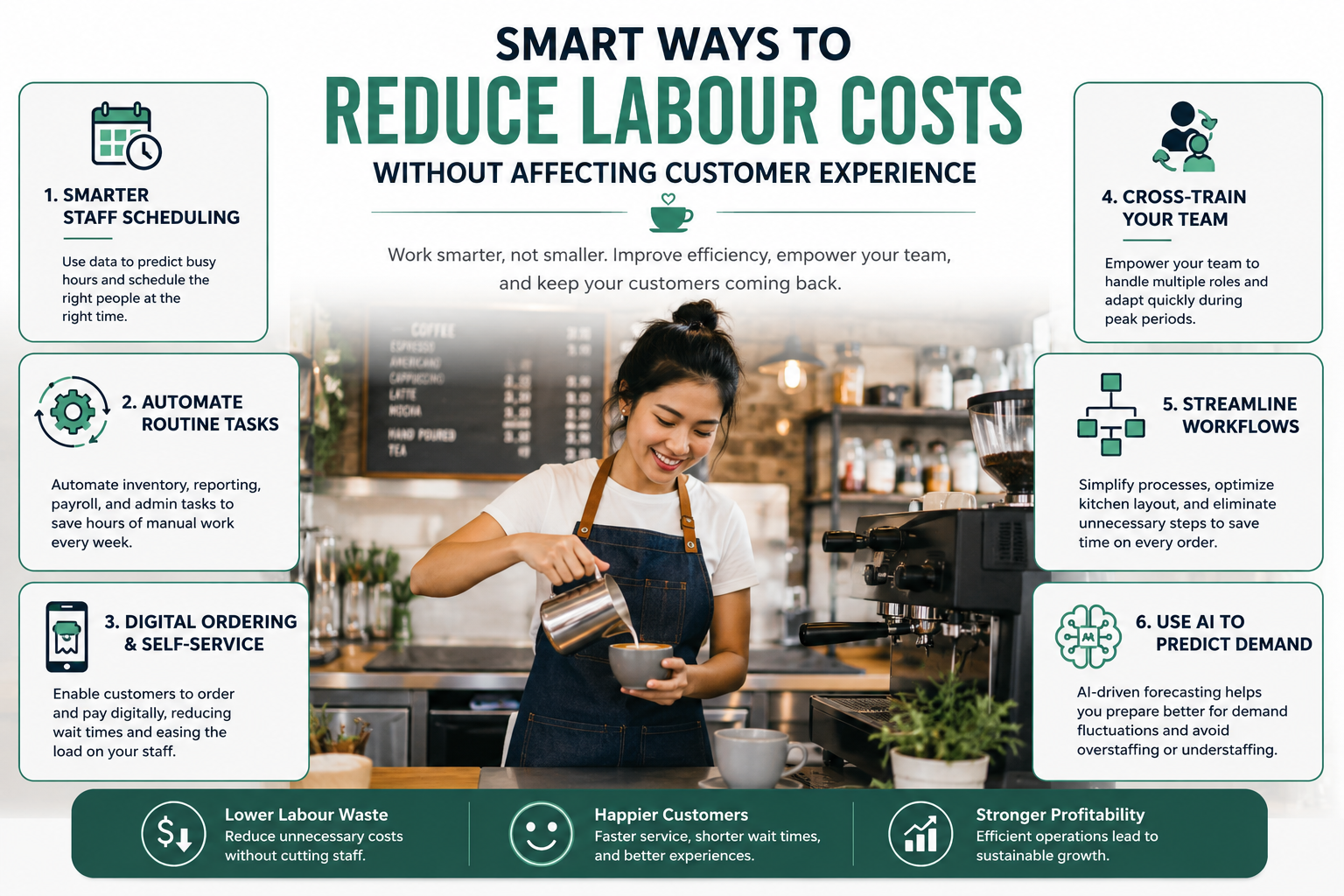
Reducing labour costs in a cafe does not mean removing the human element from hospitality. In reality, customers rarely notice how many employees are working; they notice how smoothly the experience feels. Fast service, shorter wait times, friendly interactions, and accurate orders matter far more than the size of the team behind the counter.
The most successful cafes today are focusing on operational efficiency instead of simply cutting staff. By removing repetitive work, improving workflows, and using smarter technology, cafes can reduce labour pressure while actually improving the customer experience.
Optimize Staff Scheduling Using Real Demand Data
One of the biggest reasons cafes overspend on labour is poor scheduling. Many businesses still rely on fixed weekly schedules or manager assumptions instead of actual customer traffic patterns. For example, a cafe may schedule the same number of employees on a quiet Tuesday afternoon as they would on a busy Friday evening. Over time, these small inefficiencies create major labour waste. Modern scheduling tools and AI-powered systems help cafes:
- Predict busy hours using historical sales data
- Identify slow periods accurately
- Reduce unnecessary shift overlaps
- Schedule employees based on actual demand
- Avoid both overstaffing and understaffing
According to restaurant workforce studies, optimized scheduling can reduce labour costs by up to 10–15% while improving service consistency.
The biggest advantage? Customers experience faster service during peak hours because staffing is aligned with real demand instead of guesswork.
Automate Repetitive Operational Tasks
Cafe employees often spend a surprising amount of time on tasks that do not directly improve customer experience. These include:
- Manual inventory tracking
- End-of-day reporting
- Payroll calculations
- Shift coordination
- Vendor management
- Stock counting
- Order reconciliation
When employees are buried in operational admin work, customer service naturally suffers.
Automation tools can handle many of these repetitive tasks in the background, allowing staff to focus on hospitality, speed, and customer interaction instead.
For example:
- Automated inventory systems can track ingredient usage in real time
- Smart POS systems reduce billing errors
- Payroll automation minimizes administrative workload
- Digital reporting removes manual spreadsheet management
This doesn’t replace employees; it makes employees more productive.
Introduce Digital Ordering & Self-Service Options
Customers today are already comfortable using QR menus, self-order kiosks, and mobile ordering apps. In fact, many customers prefer them because they reduce waiting time and make ordering faster. A study by Toast found that many restaurant customers prefer digital ordering because of speed and convenience.
For cafes, digital ordering can significantly reduce labour pressure by:
- Reducing order-taking bottlenecks
- Minimizing cashier dependency
- Improving order accuracy
- Speeding up table turnover
- Allowing smaller teams to handle higher-order volumes
Most importantly, staff can spend more time creating better customer interactions instead of repeatedly handling transactional tasks. The result is a smoother experience for both customers and employees.
Cross-Train Employees for Multiple Roles
Rigid staffing structures often increase labour inefficiency. If one employee can only handle billing while another only prepares beverages, operational flexibility becomes limited. Cross-training employees allows cafes to operate with leaner, more adaptable teams.
Benefits of cross-training include:
- Better shift flexibility
- Reduced idle time
- Faster service during peak hours
- Lower hiring pressure
- Improved employee skill development
Cross-trained teams also help cafes handle unexpected rushes without immediately requiring additional staff.
Simplify Workflows Inside the Cafe
Sometimes labour costs increase simply because workflows are inefficient. Small operational issues create hidden delays:
- Staff walking long distances repeatedly
- Poor kitchen layouts
- Complicated menu preparation
- Slow payment systems
- Multiple disconnected tools
Even a few extra seconds added to every order can significantly impact labour efficiency during busy hours. Many successful cafes improve productivity by:
- Redesigning preparation stations
- Streamlining kitchen movement
- Reducing unnecessary menu complexity
- Standardizing frequently ordered items
- Integrating systems into one platform
Simpler workflows reduce stress for employees and create a noticeably faster customer experience.
Use AI to Predict Demand More Accurately
AI is becoming increasingly valuable for cafe operations because customer demand is rarely consistent. Factors like:
- Weather
- Weekends
- Holidays
- Local events
- Seasonal trends
- Delivery spikes
can all impact foot traffic and staffing needs.
AI-powered operational systems can analyze these patterns and help cafe owners make smarter decisions across different vertices, like staffing, inventory purchases, shift planning, etc.
Instead of reacting to problems after they happen, cafes can proactively prepare for demand changes.
Focus Employees on Customer Experience. Not Administrative Work
Customers remember how a cafe made them feel. Friendly interactions, fast service, personalized recommendations, and smooth experiences are what drive repeat visits. When operational systems become more efficient, employees can spend more time doing high-value work:
- Engaging with customers
- Improving service quality
- Handling special requests
- Maintaining cafe atmosphere
- Building customer loyalty
That is where modern labour optimization creates the biggest impact.
The goal is not to remove people from the cafe experience. The goal is to remove wasted time from the employee experience.
How Aximise Helps Cafes Improve Operational Efficiency?
Managing labour costs is not just about reducing staff, it’s about running smarter operations. Aximise helps cafes improve efficiency using AI-driven operational insights that reduce wasted time, optimize staffing, and streamline daily workflows.
With Aximise, cafes can:
- Predict busy hours and schedule staff more accurately
- Identify slow operational bottlenecks affecting service speed
- Reduce overstaffing during low-demand periods
- Track operational inefficiencies across locations
- Improve workforce planning using real demand patterns
- Make faster decisions with centralized operational visibility
Instead of relying on guesswork, managers get clearer insights into how the cafe is actually performing day-to-day. The result is lower labour waste, smoother operations, faster customer service, and a more efficient cafe experience; without compromising hospitality or service quality.
From optimized scheduling and digital ordering to AI-driven operational insights, small operational improvements can make a major difference in long-term profitability. The goal is not to simply work with fewer people; it’s to help your team work more efficiently with the right systems and visibility in place.
As customer expectations continue to rise, cafes that embrace operational intelligence and automation will be better positioned to scale sustainably without compromising hospitality.
Looking to improve operational efficiency in your cafe? Aximise helps cafes use AI-driven operational insights to reduce inefficiencies, optimize workforce planning, and create smarter customer experiences.
- What is the ideal labour cost percentage for a cafe?
Most cafes aim to keep labour costs between 25% to 35% of total revenue. However, the ideal percentage can vary depending on the cafe format, service style, location, and operational complexity.
- How can cafes reduce labour costs without reducing staff?
Cafes can lower labour costs by improving operational efficiency instead of cutting employees. Smarter scheduling, automation, digital ordering, workflow optimization, and AI-driven forecasting can reduce wasted time and improve productivity without affecting customer experience.
- Does automation negatively affect customer experience in cafes?
Not necessarily. In many cases, automation actually improves customer experience by reducing wait times, improving order accuracy, and helping staff focus more on customer interaction instead of repetitive administrative tasks.
- How does AI help with cafe workforce management?
AI helps cafes analyze customer traffic patterns, peak hours, seasonal trends, and operational data to improve staffing decisions. This allows cafe owners to avoid overstaffing, reduce overtime costs, and maintain smoother service during busy periods.
- Why is operational efficiency important for cafe profitability?
Operational inefficiencies can increase labour costs, slow down service, and create unnecessary operational stress. Improving efficiency helps cafes reduce waste, serve customers faster, improve team productivity, and maintain healthier profit margins over time.