

Your AI project looks great on paper. The demo works. The model is impressive. Everyone’s excited.
Then someone asks the question that matters: “How much will this actually return?”
Suddenly, “AI transformation” becomes a spreadsheet problem.
And that’s where many AI projects fall apart; not because the technology fails, but because nobody defined what success should look like before the money was spent.
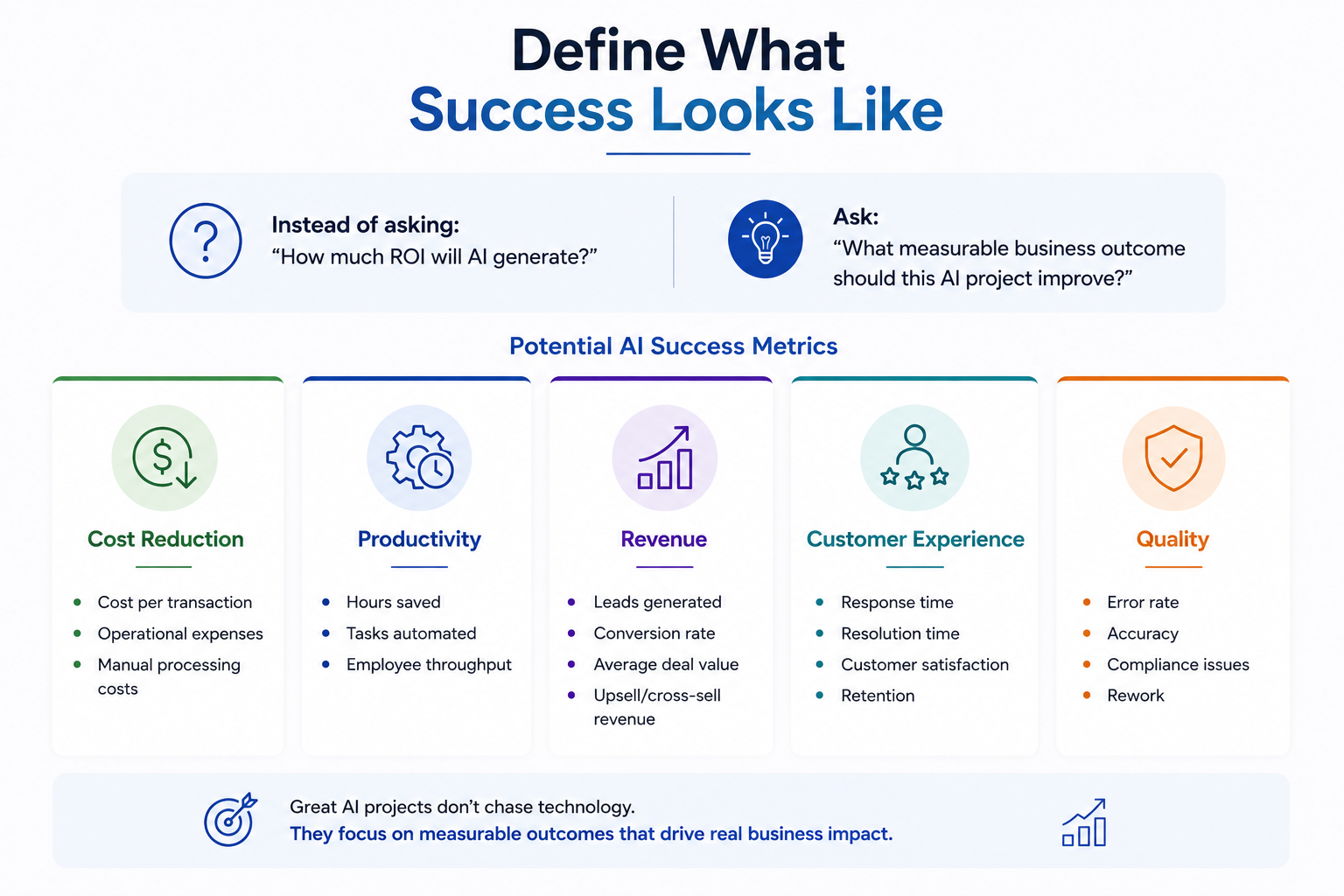
A strong AI project starts with more than a great idea. It starts with a realistic ROI model, clear success metrics, and a simple answer to one question: “What will be different for the business if this works?”
Let’s break down how to answer that question before you start building.
What Is ROI Modeling in AI?
ROI modeling for AI is the process of estimating how much business value an AI project could generate compared with what it will cost to build, deploy, and maintain. It connects technical investment to measurable outcomes such as:
- Cost savings
- Revenue growth
- Hours saved
- Faster processes
- Reduced errors
- Improved customer retention
Instead of simply asking, “Can we build this with AI?”, ROI modeling asks the more important question: “Is building this AI solution worth the investment, and how will we prove it?”
Why AI Projects Often Struggle to Deliver Expected ROI
AI projects rarely fail because the technology doesn’t work. More often, they fail because the business case was never clear enough to begin with. A promising AI use case can still deliver poor ROI when companies:
- Start With AI, Not the Problem: “Where can we use AI?” is the wrong starting point. Without a specific, costly business problem to solve, teams can end up building impressive technology with little measurable impact.
- Overestimate Productivity Gains: Saving 30 minutes per employee sounds great on paper. But if employees don’t adopt the tool, workflows don’t change, or the saved time isn’t redirected toward valuable work, those projected savings never become real business value.
- Ignore the Total Cost of AI: The initial development cost is only part of the investment. Data preparation, integrations, cloud infrastructure, model/API usage, security, monitoring, maintenance, and employee training can significantly affect the final ROI.
- Measure Activity Instead of Outcomes: More AI queries, higher user counts, or a better model accuracy score don’t automatically mean better ROI. Business outcomes matter more than AI activity. The real question is whether the project reduced costs, increased revenue, improved efficiency, or delivered another measurable business benefit.
- Set Unrealistic Expectations: ROI models built around 100% automation, instant adoption, or best-case performance create attractive forecasts—but poor decision-making. Realistic AI ROI requires conservative assumptions, clear baselines, and measurable targets.
Build the AI ROI Model
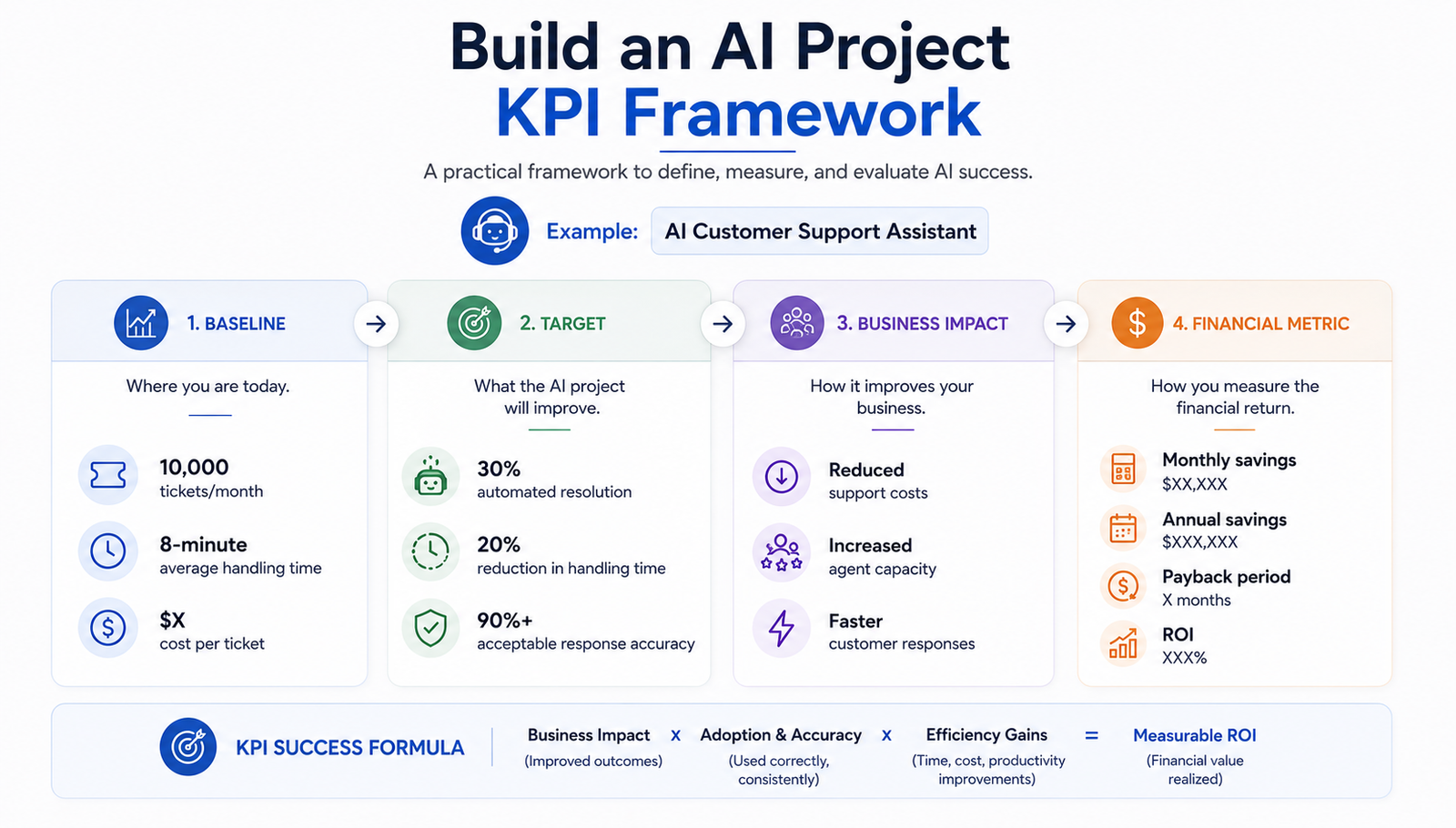
Once you know the problem, baseline, and success metrics, it’s time to put numbers behind the business case. A simple AI ROI model should answer three questions:
- What will we invest?
- What will we gain?
- And how long will it take to break even?
- Calculate the Expected Benefits: Start by translating your AI project’s expected impact into financial terms. Depending on the use case, benefits could include:
- Labor savings: Hours reduced through automation
- Revenue gains: More conversions, sales, or upsell opportunities
- Cost reduction: Lower operational or service costs
- Error reduction: Fewer mistakes, rework, refunds, or compliance issues
- Productivity gains: More work completed with the same team
- Time savings: Faster processing, decision-making, or response times
For example, if an AI tool saves 1,000 employee hours per month, don’t stop at “1,000 hours saved.” Estimate what those hours are worth to the business.
- Calculate the Total AI Investment: Don’t model ROI using development costs alone. Include the full cost of ownership, such as:
- AI development and implementation
- Data preparation and processing
- APIs and model usage
- Cloud infrastructure
- System integrations
- Testing and security
- Employee training
- Monitoring and maintenance
This gives you a more realistic picture of what the project will actually cost over time.
- Calculate ROI: A basic formula is:
ROI = (Total Benefits − Total Investment) ÷ Total Investment × 100
For example, if an AI project costs $100,000 and generates $160,000 in measurable benefits:
ROI = ($160,000 − $100,000) ÷ $100,000 × 100 = 60%
But ROI alone isn’t enough. You should also calculate the payback period—how long it takes for the project to recover its initial investment.
- Model More Than One Scenario: AI rarely performs exactly as predicted. Build at least three scenarios:
- Conservative: Lower adoption and modest business impact
- Expected: Realistic adoption and performance
- Optimistic: Strong adoption and higher-than-expected gains
This prevents your business case from depending on best-case assumptions.
The goal isn’t to make the ROI number look impressive. It’s to make the number useful enough to support a confident investment decision.
Set Leading and Lagging Success Metrics
AI ROI doesn’t always show up immediately. A project might take months to generate measurable cost savings or revenue, but you can still track whether it’s moving in the right direction. That’s why AI projects should use both leading and lagging metrics.
Leading Metrics: Are We on Track?
Leading metrics measure the signals that indicate whether the AI solution is likely to deliver its intended value. Depending on the project, these could include:
- AI adoption and active users
- Task automation rate
- AI acceptance rate
- Workflow completion rate
- Response or processing time
- Employee usage frequency
- Accuracy or successful task completion
For example, if your goal is to automate 40% of customer support tickets, AI adoption, successful resolutions, and automation rate are leading indicators that show whether you’re getting closer to that target.
Lagging Metrics: Did We Actually Create Value?
Lagging metrics measure the actual business outcomes generated after the AI solution is deployed. These could include:
- Cost savings
- Revenue generated
- Customer retention
- Reduced operational expenses
- Increased employee productivity
- Lower error rates
- Improved customer satisfaction
- Reduced time-to-market
Going back to the support example, the real lagging metrics could be reduced support costs, lower average handling time, and improved customer retention.
Track Both to Get the Full Picture
Leading metrics tell you whether the project is heading in the right direction. Lagging metrics tell you whether it ultimately delivered business value.
Tracking both helps teams identify problems early instead of waiting until the final ROI calculation to discover that the project missed its targets.
The best AI success framework doesn’t just measure whether people are using AI. It measures whether that usage is creating measurable business outcomes.
Common Mistakes in AI ROI Modeling
A good ROI model isn’t about finding the biggest possible number. It’s about creating a forecast that reflects how the AI project will perform in the real world. Yet, several common mistakes can make AI ROI projections look far better on paper than they do after deployment.
- Using Best-Case Assumptions: Assuming 100% adoption, near-perfect accuracy, or complete automation can inflate projected returns. Build conservative, expected, and optimistic scenarios instead.
- Ignoring the Full Cost of AI: Development is only the beginning. Model infrastructure, APIs, data preparation, integrations, training, monitoring, maintenance, and other ongoing costs must be included to calculate the true investment.
- Measuring AI Activity Instead of Business Impact: A high number of AI interactions doesn’t necessarily mean success. Focus on metrics tied to business outcomes such as cost reduction, revenue growth, productivity, or customer retention.
- Skipping the Baseline: Without knowing how much a process currently costs or how long it takes, there’s no reliable way to measure improvement. Establish your baseline before deployment.
- Assuming Immediate ROI: AI adoption takes time. Employees may need training, workflows may need adjustment, and models may require optimization. Build a realistic timeline for reaching your expected returns.
- Treating Model Accuracy as ROI: A highly accurate model can still produce poor ROI if it solves a low-value problem or is too expensive to operate. Technical performance and business performance are not the same thing.
- Forgetting the Cost of Inaction: ROI isn’t only about what you gain by investing in AI. Consider what the business continues to lose by not solving the problem; whether that’s rising operational costs, slow processes, missed revenue, or declining customer experience.
A realistic ROI model should challenge your assumptions, not simply justify your AI investment.
AI doesn’t create ROI simply because you deploy a model. It creates ROI when it solves the right problem, at the right cost, with outcomes you can actually measure.
Before starting an AI project, establish your baseline, define clear success metrics, account for the total cost of ownership, and model conservative, expected, and optimistic outcomes. Then keep measuring after deployment to see whether the projected value becomes real business impact.
Because the smartest AI investment isn’t the one with the most impressive technology.
It’s the one where you know exactly what you’re investing, what you’re expecting, and how you’ll measure whether it worked.
Ready to Build an AI Project With a Clear Business Case? Aximise helps businesses identify high-value AI opportunities, build practical AI solutions, and turn ambitious ideas into measurable business outcomes.
Start with the business case. Build with confidence. Scale what works.