
Organizational Knowledge Intelligence Platform (RAG-Based LLM System)
Growing organizations accumulate knowledge across documents, SOPs, emails, wikis, support tickets, and internal systems. As these knowledge repositories expand, finding the right information becomes increasingly difficult, leading to duplicated work, inconsistent answers, and slower decision-making.
The client needed an AI-powered knowledge platform that could securely unify enterprise information and provide employees with accurate, context-aware answers using Retrieval-Augmented Generation (RAG). Instead of relying solely on a Large Language Model, the solution grounds responses in the organization’s own knowledge base, using relevant retrieved information as context.
Aximise built a scalable Organizational Knowledge Intelligence Platform that processes and organizes enterprise content, retrieves relevant knowledge, generates contextual responses, and continuously evaluates answer quality while providing visibility into system usage and AI costs.
Problem Points
- Organizational knowledge scattered across multiple systems and documents
- Employees spending excessive time searching for information
- Traditional keyword search making relevant information difficult to find
- Inconsistent answers across teams and knowledge sources
- Growing knowledge repositories becoming harder to manage
- Risk of LLM hallucinations and unsupported responses
- Need to provide answers grounded in organizational knowledge
- Retrieval quality directly affecting the quality of AI responses
- Need to monitor LLM usage and associated costs
- Lack of centralized visibility into platform health and usage

Solutions Implemented
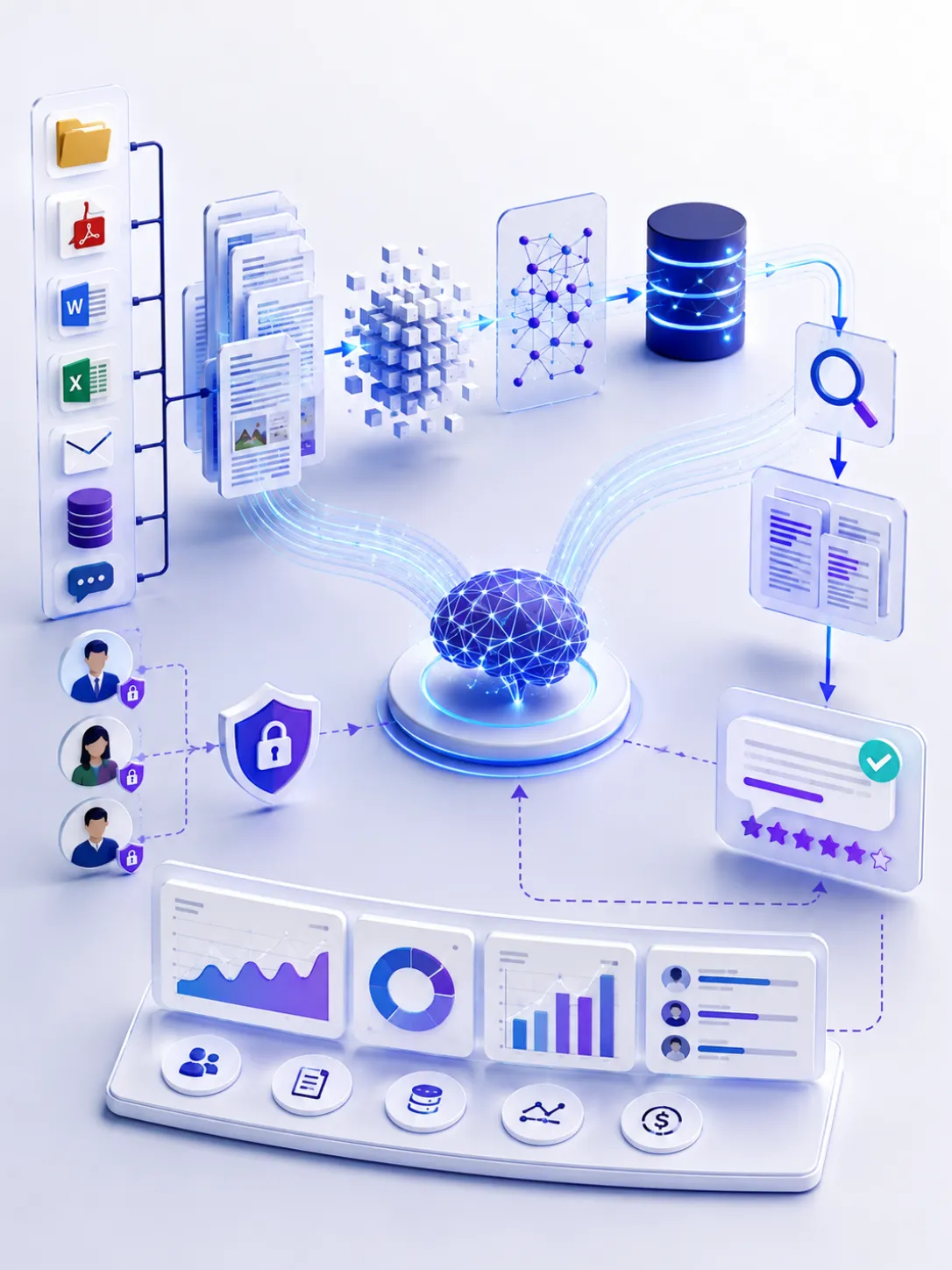
- Built a Retrieval-Augmented Generation (RAG) architecture for enterprise knowledge intelligence
- Ingested and processed organizational content from multiple knowledge sources
- Implemented document chunking to break large documents into retrieval-ready knowledge units
- Generated semantic embeddings to represent organizational content for intelligent retrieval
- Built vector-based retrieval workflows to identify relevant knowledge for each query
- Designed retrieval workflows to provide relevant context to the LLM before response generation
- Implemented caching mechanisms to improve response efficiency and reduce unnecessary processing
- Used LLMs to generate context-aware responses grounded in retrieved organizational knowledge
- Added scoring mechanisms at the end of AI responses to evaluate answer quality
- Used answer scoring to improve RAG prompt outputs and response quality over time
- Implemented source citations to provide greater transparency into generated answers
- Added role-based access controls to ensure users only access authorized information
- Built an administrative monitoring panel for platform health and operational visibility
- Added usage reporting to track token consumption across users
- Enabled monitoring of LLM usage across different models
- Added AI cost tracking based on token usage and selected LLMs
Key Features Added
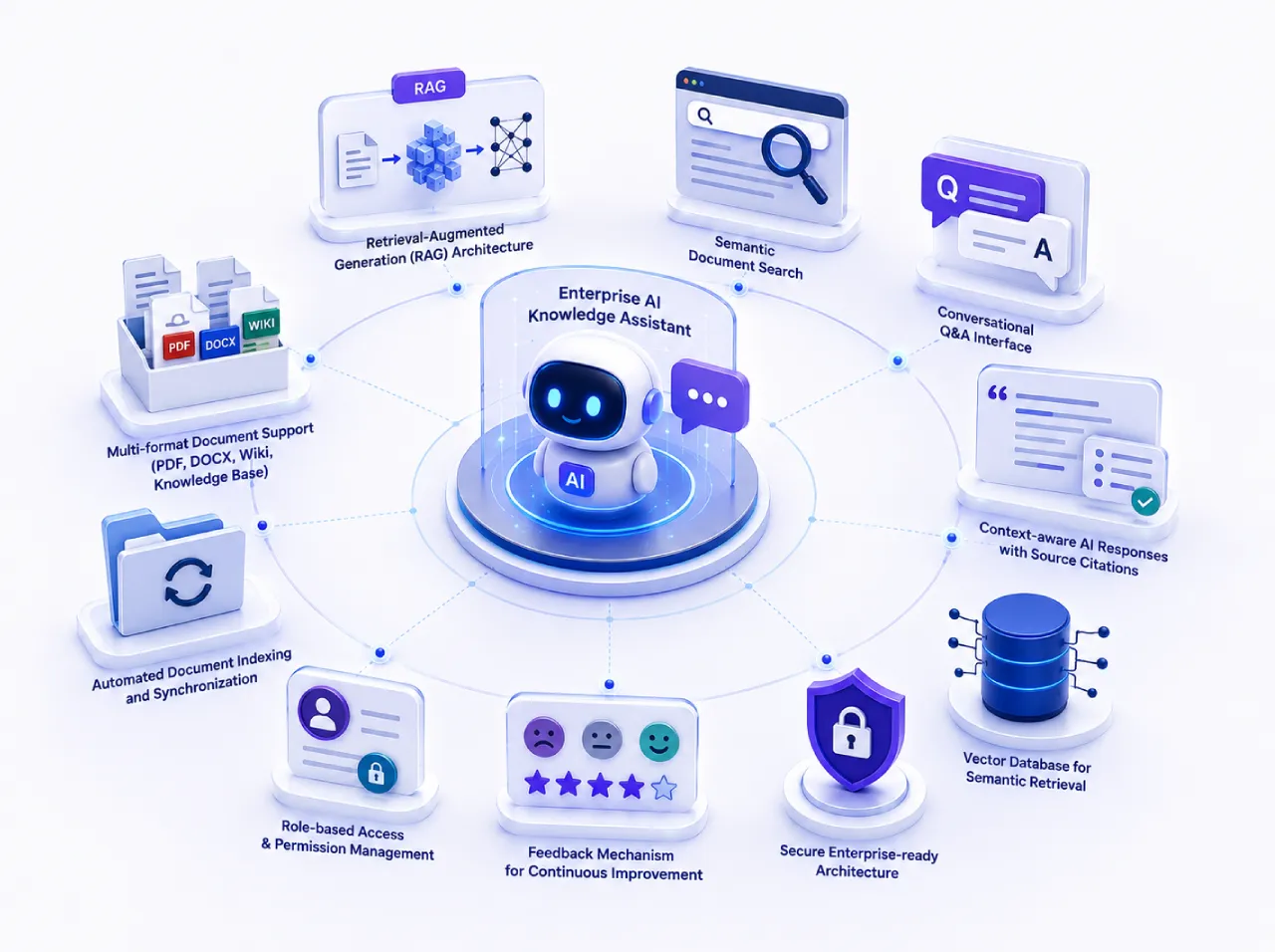
- Enterprise AI knowledge assistant
- Retrieval-Augmented Generation (RAG) architecture
- Semantic document search
- Conversational question-answering interface
- Context-aware AI responses with source citations
- Automated document indexing and synchronization
- Multi-format document support (PDF, DOCX, Wiki, Knowledge Base)
- Role-based access and permission management
- Vector database for semantic retrieval
- Secure enterprise-ready architecture
- Feedback mechanism for continuous improvement
Business Impact
The Organizational Knowledge Intelligence Platform transformed fragmented organizational knowledge into an intelligent, searchable resource. Employees can now interact with enterprise information through natural language instead of manually searching across multiple systems.
By combining document chunking, semantic embeddings, intelligent retrieval workflows, caching, and RAG-based response generation, the platform delivers context-aware answers grounded in organizational knowledge. Answer scoring mechanisms provide an additional evaluation layer that helps improve RAG prompt outputs and overall response quality.
The platform also gives administrators greater visibility into the health and economics of the AI system through centralized reporting on user activity, token consumption, LLM usage, and associated costs.
As a result, time spent searching for relevant information was reduced by 45%, while the organization gained a more scalable, governed, and measurable approach to enterprise knowledge management.