
Your company’s knowledge is everywhere. And that’s the problem.
When critical information lives across disconnected systems, finding the right answer becomes harder than solving the problem itself.
What Is Scattered Organizational Knowledge?
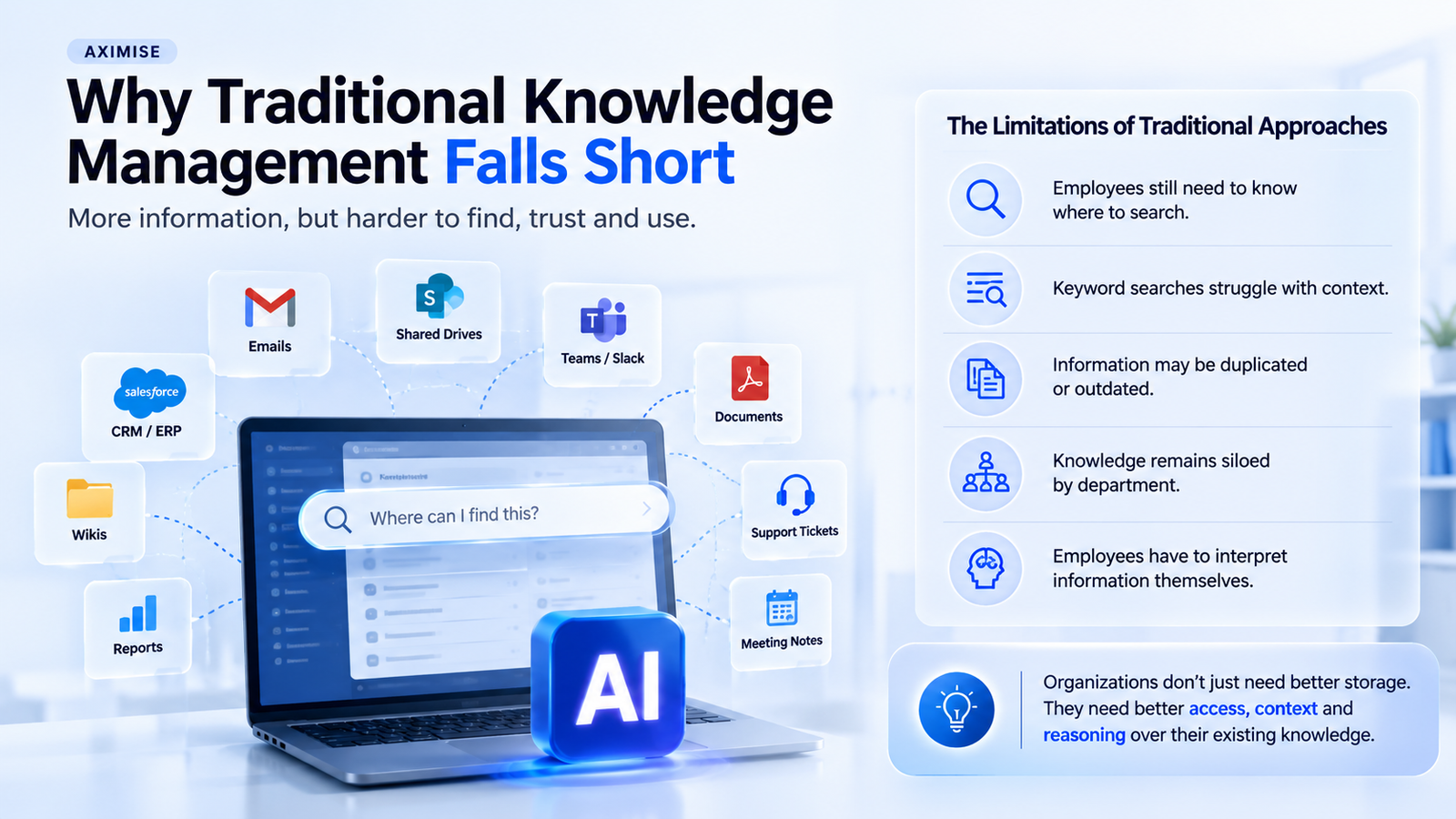
Your organization’s knowledge rarely lives in one place. It’s spread across documents, emails, CRM systems, project tools, internal chats, wikis, reports, and often people’s heads. This is scattered organizational knowledge: valuable information that exists across disconnected sources without a unified way to find, understand, and use it.
The problem isn’t the lack of information. It’s the lack of access and context.
An employee may need a simple answer but have to search through multiple folders, check old emails, ask a colleague, or compare several versions of a document before finding what they need. Meanwhile, another team may already have the exact information.
Over time, this creates knowledge silos, duplicated work, inconsistent decisions, and dependency on individual employees. Common sources of scattered knowledge include:
- Internal documents, PDFs, and presentations
- Emails and meeting notes
- CRM, ERP, and business systems
- Customer support tickets and conversations
- Project management platforms
- Internal wikis and knowledge bases
- Slack, Teams, and other communication channels
- Historical reports and business records
- Employee experience and institutional knowledge
The real challenge isn’t storing more information. It’s turning the information an organization already has into knowledge people can actually access and act on.
The Hidden Costs of Scattered Knowledge
Scattered knowledge may look like an internal efficiency issue, but its impact extends across productivity, decision-making, employee experience, and customer relationships. When teams cannot quickly find and trust the information they need, small inefficiencies begin to compound into significant business costs.
Productivity Loss: Employees often spend more time finding information than using it. They search through folders, emails, internal chats, and multiple systems, then spend additional time checking whether the information they found is current.
For example, a sales representative may spend 30 minutes searching for the latest pricing document and another 20 minutes confirming whether it is still valid. Multiply that across hundreds of employees and repeated searches, and the lost productivity becomes substantial.
The cost isn’t simply the minutes spent searching. It is the work that could have been completed during those minutes.
Repetitive Work: When organizational knowledge is difficult to access, teams often end up solving the same problems repeatedly.
- Customer support looks up the same product information across different sources.
- HR teams repeatedly answer questions that are already covered in internal policies.
- Engineers troubleshoot issues that someone else has already resolved.
- Sales teams recreate proposals, presentations, or responses that already exist.
Instead of building on existing knowledge, employees spend valuable time rediscovering it. Over time, this creates unnecessary workloads and prevents teams from focusing on higher-value work.
Slower Decision-Making: Good decisions depend on having the right information at the right time. But when relevant knowledge is fragmented across systems, decision-makers rarely have the complete picture in front of them. They may have to work with:
- Outdated reports
- Partial information
- Manual research
- Individual opinions or expertise
- Incomplete historical context
This slows down decision cycles and increases the risk of decisions being based on assumptions rather than organizational knowledge. The longer it takes to find the right context, the longer it takes to act.
Loss of Institutional Knowledge: Some of an organization’s most valuable knowledge never makes it into a document. An experienced employee may understand not only what a process requires, but why it exists, what exceptions to consider, and what mistakes to avoid. When that employee leaves, much of this context can leave with them.
A process document might tell a new employee: “Follow these five steps.”
Institutional knowledge explains:
- Why those five steps exist
- What to do when the standard process doesn’t apply
- What has failed in the past
- Which stakeholders need to be involved
- What warning signs to watch for
This distinction matters because documented information can be stored, but contextual knowledge needs to be captured and made accessible.
Knowledge Silos: Different departments naturally develop their own information ecosystems. The problem begins when those ecosystems remain disconnected. Consider how different teams may view the same customer:
- Sales → Customer requirements and commercial expectations
- Support → Customer issues and service history
- Product → Feature requests and roadmap priorities
- Engineering → Technical constraints and implementation details
- Leadership → Business priorities and strategic objectives
Each team may have accurate information, but no single team has the complete context. These silos can lead to inconsistent answers, duplicated effort, missed insights, and decisions that make sense from one department’s perspective but not the organization’s as a whole.
Poor Employee Onboarding: For new employees, scattered knowledge can turn the first few weeks into a process of figuring out where everything lives. They need to discover:
- Where important information is stored
- Which documents are actually relevant
- Who to approach for specific questions
- Which processes are current
- How previous decisions were made
This often creates an unofficial onboarding system: “Ask someone who has been here longer.”
The result is longer time-to-productivity and greater dependency on experienced employees who are already managing their own responsibilities.
Customer Experience Impact: The effects of scattered knowledge don’t stay inside the organization. Eventually, customers feel them too. When employees can’t access the right information quickly, customers may experience:
- Inconsistent answers from different teams
- Longer resolution times
- Unnecessary escalations
- Repeated requests for the same information
- Missed context from previous interactions
A customer doesn’t see the disconnected systems behind the scenes. They simply experience delays, confusion, or inconsistent service.
That is why scattered organizational knowledge is more than an internal productivity problem. It can directly influence how efficiently a business operates and how customers experience it.
Real-World Use Cases
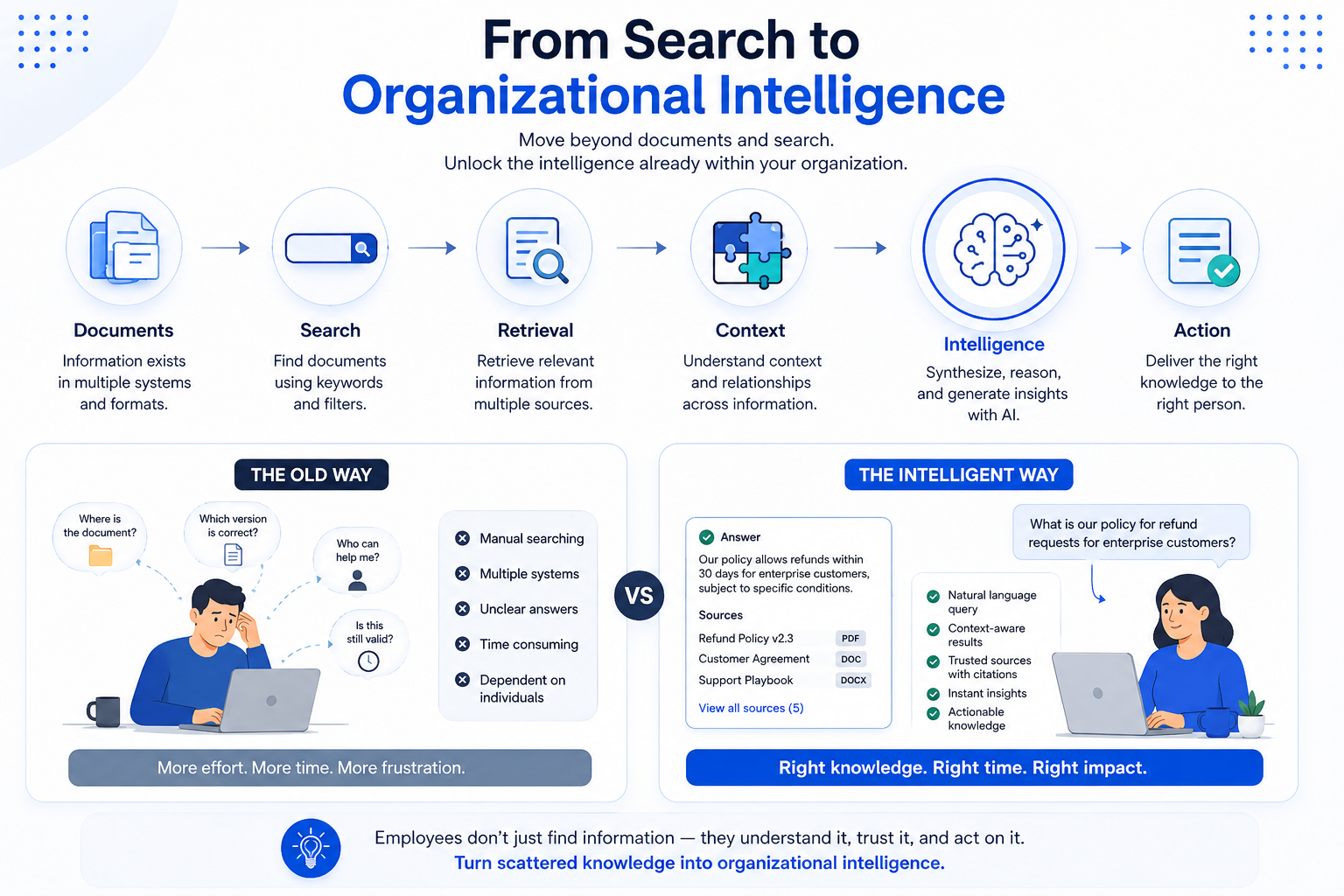
An intelligent organizational knowledge system can help teams turn scattered information into accessible, actionable knowledge across everyday workflows.
Customer Support
- Quickly retrieve product documentation, customer history, troubleshooting guides, and previous resolutions.
- Provide consistent answers across support agents and channels.
- Reduce unnecessary escalations and improve resolution times.
- Surface relevant knowledge based on the customer’s specific issue or context.
Sales
- Find relevant proposals, case studies, pricing information, product documentation, and past customer interactions.
- Give sales teams quick access to information during customer conversations.
- Reduce time spent recreating presentations and proposals.
- Help representatives identify relevant solutions based on customer requirements.
Human Resources
- Answer employee questions using approved policies, benefits information, onboarding documents, and internal guidelines.
- Reduce repetitive questions handled manually by HR teams.
- Help employees find the right information without searching through multiple internal systems.
- Make organizational policies easier to access and understand.
Engineering & IT
- Surface technical documentation, architecture decisions, incident reports, and troubleshooting knowledge.
- Help engineers identify how similar technical issues were resolved previously.
- Reduce dependency on individual experts for routine questions.
- Preserve technical knowledge when team members move roles or leave the organization.
Leadership & Decision-Making
- Bring together information from reports, business documents, historical records, and departmental data.
- Quickly summarize relevant organizational knowledge before important decisions.
- Provide context around previous decisions, initiatives, and business outcomes.
- Reduce time spent manually gathering information from multiple teams.
Employee Onboarding
- Give new employees a single, intelligent way to discover organizational knowledge.
- Help them understand processes, tools, policies, and historical context faster.
- Reduce dependency on experienced employees for basic questions.
- Shorten the time it takes for new hires to become productive.
Cross-Functional Collaboration
- Connect information across departments instead of keeping knowledge within individual silos.
- Give teams visibility into relevant customer, product, operational, and business context.
- Reduce duplicated work caused by disconnected information.
- Help employees make decisions using a more complete view of organizational knowledge.
Your organization may already have the knowledge it needs to work faster, make better decisions, and serve customers more effectively. The challenge is that this knowledge is often scattered across systems, documents, conversations, and people.
When employees spend time searching, teams repeat work, decisions lack context, and critical expertise leaves with employees, the cost of fragmented knowledge quietly compounds.
The answer isn’t another folder or knowledge repository. Organizations need a smarter way to connect, retrieve, understand, and use the knowledge they already have.
Turn Scattered Knowledge Into Organizational Intelligence
Aximise helps organizations build AI-powered knowledge solutions that bring fragmented enterprise information together and make it accessible through intelligent, context-aware retrieval. Ready to make your organizational knowledge work harder? Talk to Aximise about building an intelligent knowledge platform for your organization.