

Imagine this.
A vehicle has just been repossessed. The recovery agent is uploading a dozen photos from the field. The asset’s value can only be figured out after spotting the little details, such as a dented bumper, a broken headlight, or even missing trim signifying previous damage, in the images. Before a decision is taken, the images need to be studied, findings documented, condition estimated, and a report prepared.
Try multiplying this process by hundreds or even thousands of vehicles every month.
Vehicle inspections as risk management tools for auto lenders are a necessity, but a major use of resources. Taking photos is probably the last thing that complicates the issue; it’s the ability to turn those photos into correct, consistent, and actionable revelations in time to support the different decisions, such as lending, recovery, and remarketing, that is most problematic.
That is why artificial intelligence is altering the prospects of the game. The combination of computer vision and automated analysis used by AI technology during vehicle inspections helps in recognizing the damage, standardizing the assessment, and sharply cutting down the need for manual review, among other things. Accordingly, lenders are able to gain quicker insights into the conditions of the assets, enhance operational efficiency, and at the same time make better decisions throughout the vehicle lifecycle.
No one is questioning the feasibility of automating the inspections any longer; however, investing in AI-driven inspection technology has suddenly become a priority for many more lenders than before.
The Growing Importance of Vehicle Condition Data in Auto Lending
In auto lending, a vehicle is more than just collateral; it’s a financial asset whose condition directly influences risk, value, and profitability. Yet many lending decisions are still made using incomplete, outdated, or inconsistent vehicle condition information.
A vehicle that appears to be worth a certain amount on paper may tell a very different story when inspected closely. Hidden damage, excessive wear and tear, missing components, or poor maintenance can significantly impact its actual market value. For lenders, having accurate and timely vehicle condition data is essential for making informed decisions throughout the lending lifecycle.
Why Inspections Matter? Vehicle inspections provide lenders with a clear picture of an asset’s condition, helping them assess risk more accurately and protect the value of their portfolio.
Inspections play a critical role at multiple stages, including:
- Loan Origination: Verifying the condition and value of the vehicle before financing is approved.
- Lease Returns: Determining wear and tear, potential repair costs, and residual value.
- Repossessions: Assessing vehicle condition quickly to support recovery and resale decisions.
- Asset Recovery and Remarketing: Establishing fair market value and identifying damages before the vehicle enters the resale market.
When lenders have reliable inspection data, they can make faster decisions, reduce uncertainty, and improve asset management outcomes.
The Cost of Inaccurate Assessments
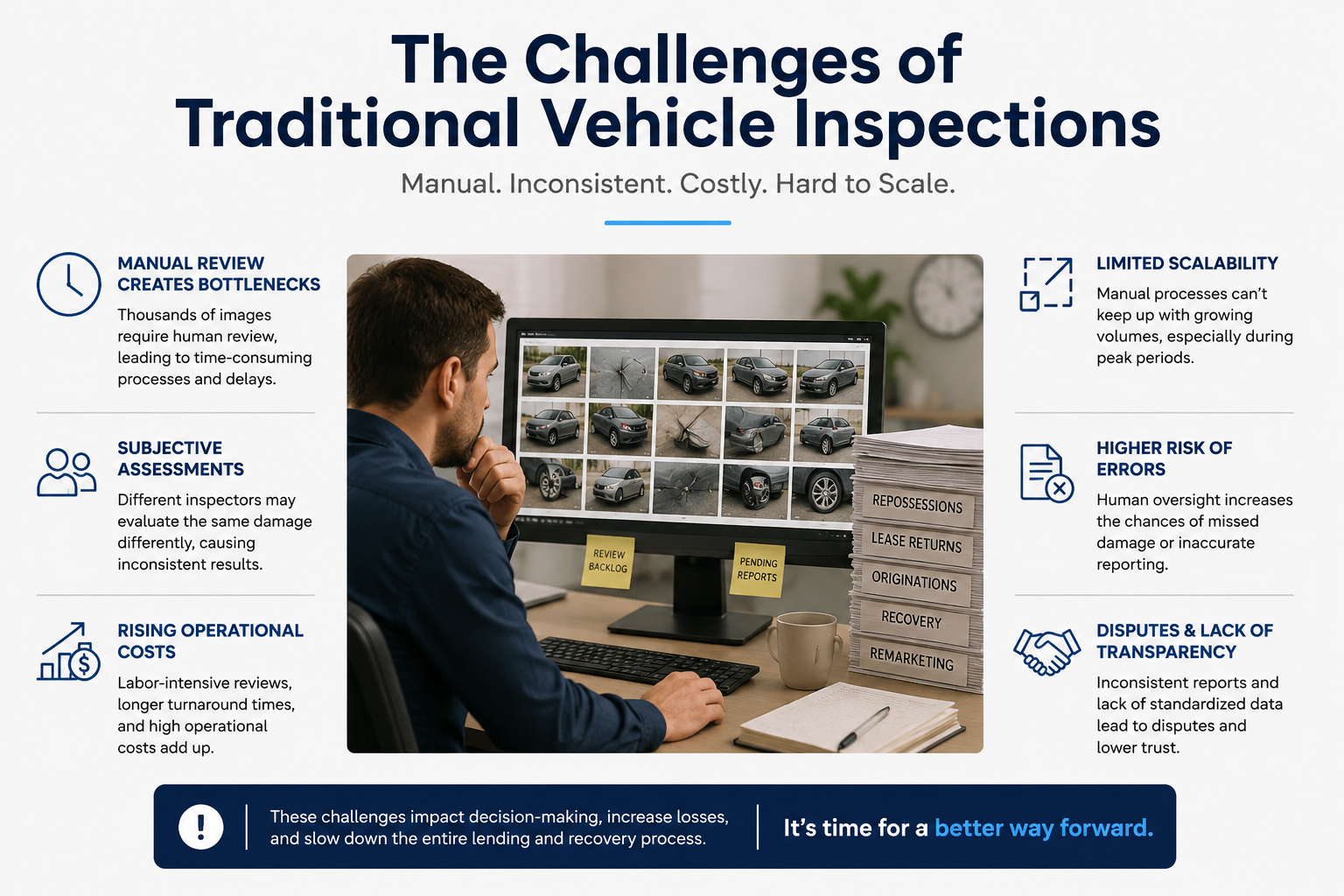
The consequences of poor or inconsistent inspections can extend far beyond a simple reporting error. An inaccurate assessment can lead to:
- Incorrect Vehicle Valuations: Overestimating or underestimating an asset’s true worth.
- Higher Recovery Losses: Unexpected damage may reduce resale value and increase financial losses.
- Delayed Decision-Making: Manual reviews and disputed findings can slow down critical recovery and remarketing processes.
- Disputes Over Vehicle Condition: Inconsistent assessments often create disagreements between lenders, recovery agents, auction partners, and customers.
As vehicle portfolios grow and operational pressures increase, lenders can no longer afford to rely solely on fragmented inspection processes. Accurate vehicle condition data has become a critical business requirement; one that directly impacts profitability, risk management, and operational efficiency.
What Are AI-Powered Vehicle Inspections?
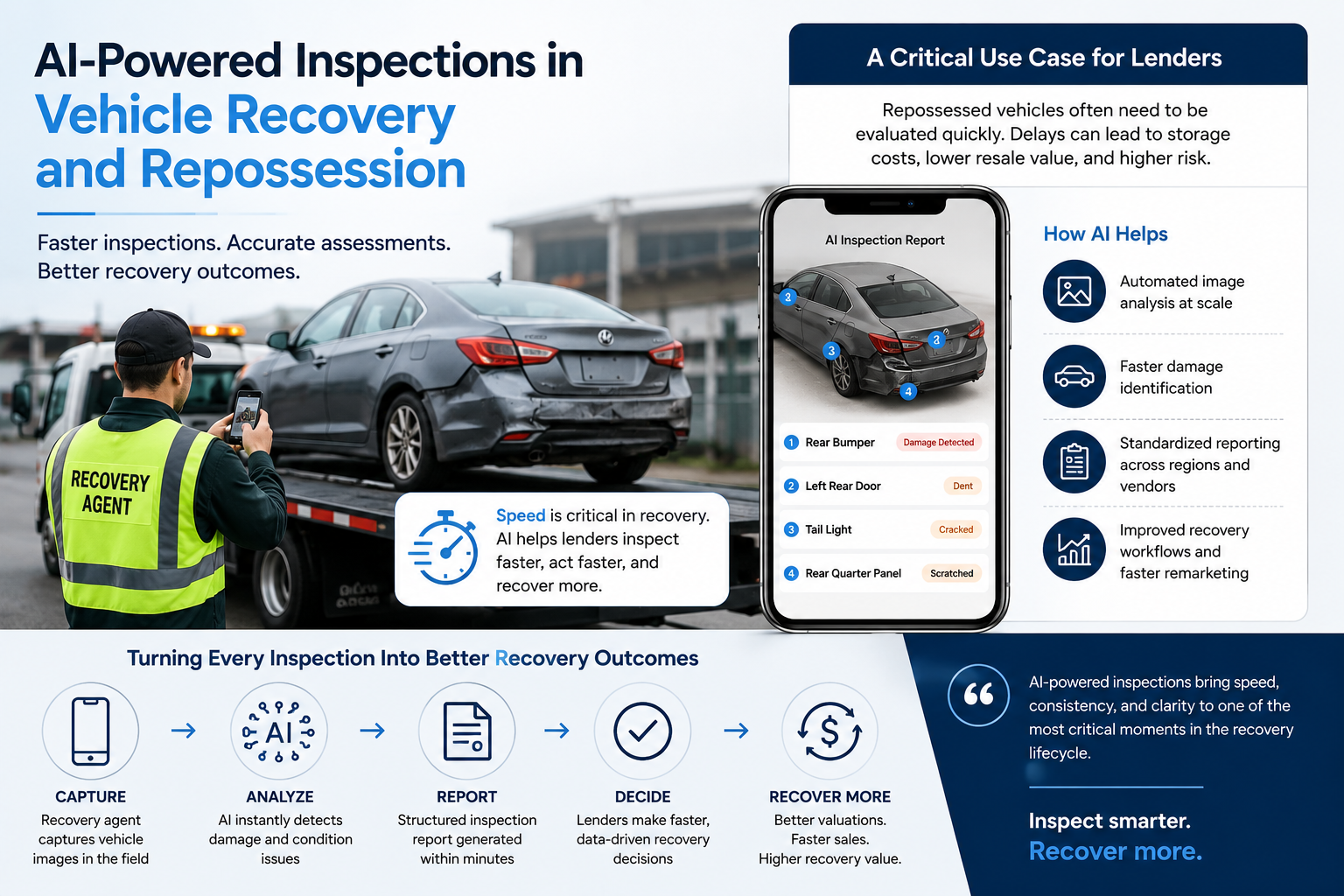
AI-powered vehicle inspections use artificial intelligence and computer vision technology to automatically analyze vehicle images and identify visible damage, defects, and condition-related issues. Instead of relying solely on manual reviews, AI can quickly assess photos, detect dents, scratches, broken parts, or missing components, and generate structured inspection reports. By transforming raw vehicle images into actionable insights, AI helps lenders, recovery teams, and asset managers make faster, more consistent, and data-driven decisions. The result is a more efficient inspection process that reduces manual effort while improving accuracy and scalability.
Why Auto Lenders Are Making the Investment?
AI-powered vehicle inspections are no longer viewed as an experimental technology. For many auto lenders, they have become a practical solution to some of the industry’s biggest operational and risk management challenges. From improving efficiency to reducing losses, the business benefits are driving increased adoption across the lending lifecycle.
Faster Inspection Turnaround: Traditional inspections can take hours or even days when images need to be manually reviewed and documented. AI dramatically shortens this process by analyzing vehicle photos within minutes. Faster inspections mean lenders can make critical decisions sooner, whether it’s approving a loan, assessing a lease return, or determining the value of a repossessed vehicle. This accelerated workflow helps reduce delays and improve overall operational efficiency.
More Consistent Assessments: One of the biggest challenges with manual inspections is inconsistency. Different inspectors may evaluate the same vehicle differently, leading to variations in reports and valuations. AI helps standardize the inspection process by applying the same evaluation criteria across every vehicle. This reduces subjectivity, improves reporting accuracy, and creates greater confidence in inspection results.
Better Portfolio Risk Management: Accurate vehicle condition data provides lenders with a clearer understanding of the assets backing their loans. With AI-generated insights, lenders can assess risk more effectively, improve asset valuations, and gain better visibility into the health of their portfolio. This level of accuracy also supports more reliable forecasting of recovery outcomes, helping lenders make smarter financial decisions.
Lower Operational Costs: As inspection volumes increase, scaling manual review teams can become costly and inefficient. AI helps reduce the amount of time spent on routine inspections, allowing teams to focus on exceptions and higher-value tasks. By automating large portions of the inspection process, lenders can handle greater volumes without proportionally increasing staffing requirements, leading to significant cost savings over time.
Improved Customer and Partner Experience: Speed and transparency matter to everyone involved in the lending ecosystem. Faster inspections lead to quicker responses for borrowers, recovery agents, auction partners, and remarketing teams.
AI-generated reports also provide clear, documented evidence of vehicle condition, helping reduce disputes and improve trust across the process. The result is a smoother experience for all stakeholders while maintaining greater transparency and accountability.
What the Future Looks Like?
Vehicle inspections powered by AI are not just about detecting damage on the surface at the moment, though that is what we are most familiar with. As computer vision and machine learning technologies get better, the information that lenders can get about vehicle conditions, values, and risks will be more comprehensive and detailed.
In the future, such systems might automatically determine the cost of repairs, forecast the impact of damages on resale value, and even convey up-to-the-minute evaluations via a mobile phone. When tied with lending, recovery, and remarketing platforms, AI will make decision-making quicker and more integrated over the whole vehicle lifecycle.
What is even more significant is that vehicle inspections won’t be viewed as a mere reactionary process anymore but instead, as a wise source of intelligence. Rather than just recording damages, the lenders will have the opportunity to utilize the inspection data for recognizing trends, forecasting recovery results, and making better portfolio decisions. Greatly, for auto lenders, the future is not about just automating the processes of inspections; rather, it is all about turning vehicle data into a winning edge.
As vehicle portfolios grow and operational pressures increase, auto lenders need faster, more accurate ways to assess vehicle condition and manage risk. AI-powered vehicle inspections are helping organizations move beyond manual processes by delivering greater consistency, improved visibility into asset conditions, and faster decision-making across lending, recovery, and remarketing operations.
However, successful implementation requires more than just AI technology—it requires solutions that fit seamlessly into existing workflows and deliver measurable business value.
At Aximise, we help organizations build and deploy practical AI solutions that solve real-world operational challenges. From computer vision-powered vehicle inspections to intelligent automation and data-driven decision-making systems, our team works with lenders to create scalable solutions that improve efficiency, reduce costs, and strengthen risk management.
Ready to explore how AI-powered vehicle inspections can transform your operations? Contact Aximise today at info@aximise.com to discover how custom AI solutions can help you streamline inspections, improve asset recovery outcomes, and make smarter lending decisions at scale.