
You launched the app. You set up the points system. You ran the sign-up promotion. Hundreds of customers enrolled.
And then… not much happened.
Visits didn’t increase noticeably. Redemption rates stayed flat. The customers who signed up still don’t come in any more often than before. Every month, your loyalty platform costs you money while sitting largely idle.
If this sounds familiar, you’re not alone, and it’s not a marketing problem. It’s a data problem. Specifically, it’s the problem of having customer data and doing nothing intelligent with it.
Most franchise loyalty programmes are stuck in 2010. They were built to collect points, not build relationships. In a world where Starbucks, Chipotle, and McDonald’s are running AI-powered personalisation engines, sending the right offer to the right customer at exactly the right moment, a generic “earn a free drink after 10 visits” isn’t going to move the needle.
The good news: the fix isn’t expensive or technically complex. It’s available to individual franchise operators right now. And it starts with understanding why your current programme is failing.
The loyalty paradox: Members of loyalty programmes generate 12–18% more incremental revenue per year than non-members. Top-performing programmes boost revenue by 15–25% annually. The operative word is use those programmes that don’t engage members, don’t deliver those returns.
Why Most Franchise Loyalty Programmes Fail
There are four failure patterns we see consistently across franchise operators:
- Generic Rewards That Don’t Feel PersonalA points-for-purchases structure tells customers nothing other than “we’ll give you something free eventually.” It doesn’t acknowledge what they order, how often they visit, or what would actually bring them back sooner.Guests want offers that reflect how they actually dine, what they order, when they visit, and how often they return. Generic rewards don’t deliver that.
- Rewards That Take Too Long to Earn86% of consumers say that when rewards feel too distant to earn, they disengage from the programme entirely. Most franchise programmes set redemption thresholds that are technically achievable but feel so remote that customers stop trying long before they get there.
- No Re-Engagement for Lapsed CustomersA customer visits three times in January, then goes quiet in February. Most loyalty systems do absolutely nothing. That customer is quietly churning and would likely come back for the right offer at the right moment. But without automation, no one notices until it’s too late.
- The Same Message to EveryoneYour breakfast regular gets the same email as your Friday-evening family table. Your health-conscious frequent visitor gets the same promo as your occasional treat-yourself customer. When every communication feels like a mass blast, it reads as spam and gets ignored.
The stat that should concern every franchise owner: 50% of loyalty programme cancellations happen within the first year of membership. The primary reason? Consumers didn’t use the benefits enough to justify the cost. Half your enrolled members are already on their way out, not because your product is bad, but because the programme never made them feel seen.
What AI Actually Changes
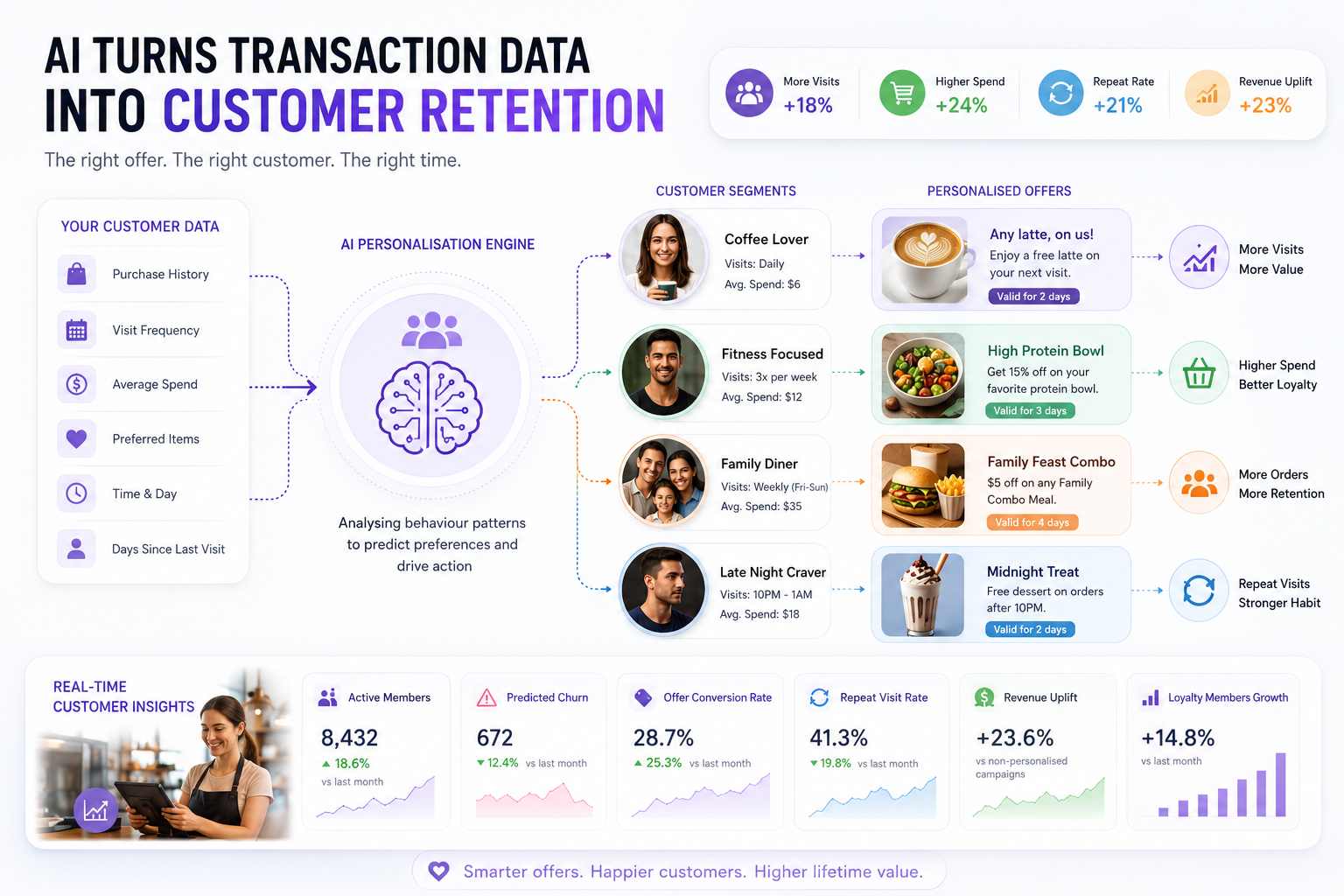
AI doesn’t replace your loyalty programme. It makes the one you already have significantly smarter by turning passive transaction data into active, personalised engagement.
Here’s what that looks like across four high-impact areas:
1. Personalised Offers That Actually Convert
Instead of blasting the same offer to all 800 loyalty members, AI segments your customer base by behaviour visit frequency, average spend, preferred items, time of day, and days since last visit then triggers personalised communications automatically.
In practice:
- The customer who visits every Monday morning gets a midweek incentive to add a second visit
- The customer who always adds a protein upgrade gets an offer built around that exact behaviour
- The customer who hasn’t visited in 28 days gets a time-sensitive re-engagement reward before they slip into full churn
AI-driven personalisation directly reduces cart abandonment rates which run as high as 60–80% for restaurant apps by replacing generic blasts with behaviour-driven, dynamic messaging.
Real-world proof: Chipotle’s personalised decision engine helped grow its rewards programme by nearly 14% to over 36 million members. That level of personalisation is no longer exclusive to chains with eight-figure marketing budgets.
2. Predictive Re-Engagement Catching Customers Before They Churn
The highest-value AI use case in loyalty programmes requires no new infrastructure. It uses data you already have: predicting which customers are about to go quiet and triggering re-engagement before they do.
AI models flag churn signals from your transaction history. A customer who normally visits weekly but hasn’t been in for 18 days is trending toward lapse. An automated, personalised message on day 20 catches them at the precise moment they’re most likely to return.
Without AI, this requires someone manually reviewing your customer list every week. With AI, it runs silently in the background every day, across your entire member base.
The retention economics: It costs 5 to 25 times more to acquire a new customer than to retain an existing one. A 5% improvement in customer retention can increase profit by 25–95%. For a franchise owner with 2,000 loyalty members, recovering just 5% of lapsing customers per month delivers far more value than the tool costs to run.
3. Smarter Upsell at the Point of Decision
The loyalty opportunity doesn’t only exist in your email campaigns. It exists at the moment a customer is about to order.
AI-powered upsell tools available as POS integrations surface the add-on or upgrade each customer is statistically most likely to accept, based on their personal order history and behaviour patterns from similar customers.
- The customer who always orders a base item but has never tried the premium version gets a nudge at checkout
- The lunchtime regular gets a dinner-visit incentive displayed during their morning order
- New customers see recommendations based on what similar first-time visitors ordered next
Even a $0.75 average upsell across 200 daily transactions is $150/day over $54,000 annually from a tool that costs a fraction of that to operate.
4. Loyalty Analytics That Actually Tell You SomethingMost franchise loyalty dashboards show three things: total members, total points issued, and total redemptions. That’s not insight, it’s a scoreboard with no strategy attached.
AI analytics layers on top of your existing data and surfaces what actually changes how you operate:
- Which customer segments are your highest lifetime value, and what behaviour preceded that
- Which promotions drove genuine incremental visits versus simply rewarding customers who would have come anyway
- Which time windows or locations are underperforming on loyalty redemption, and why
Businesses using personalised marketing see customer loyalty improve by 47% and customer satisfaction by 36%. But personalisation only works when you know which customers to personalise for, and that insight comes from analytics, not gut feel.
The Franchise Loyalty Gap And Why Now Is the Time to Close It
The gap between how enterprise chains run loyalty and how most individual franchise operators run it is wide and widening.
Only 39% of restaurants currently use AI-driven personalisation in their loyalty programmes, compared to a 51% global average across industries. The majority of franchise operators are still running programmes that collect data without ever activating it.
That’s a competitive vulnerability. It’s also a window. The franchisees who move now, before AI-powered loyalty becomes the industry standard, will build a retention advantage that compounds every month.
The maths every franchise owner should run: Companies leading in loyalty experience 2.5 times faster revenue growth than competitors. Loyal customers spend 43% more. For a franchise generating $800,000 annually, a 10% improvement in repeat visit rate from existing loyalty members adds $80,000 to the top line before a single new customer is acquired.
Where to Start
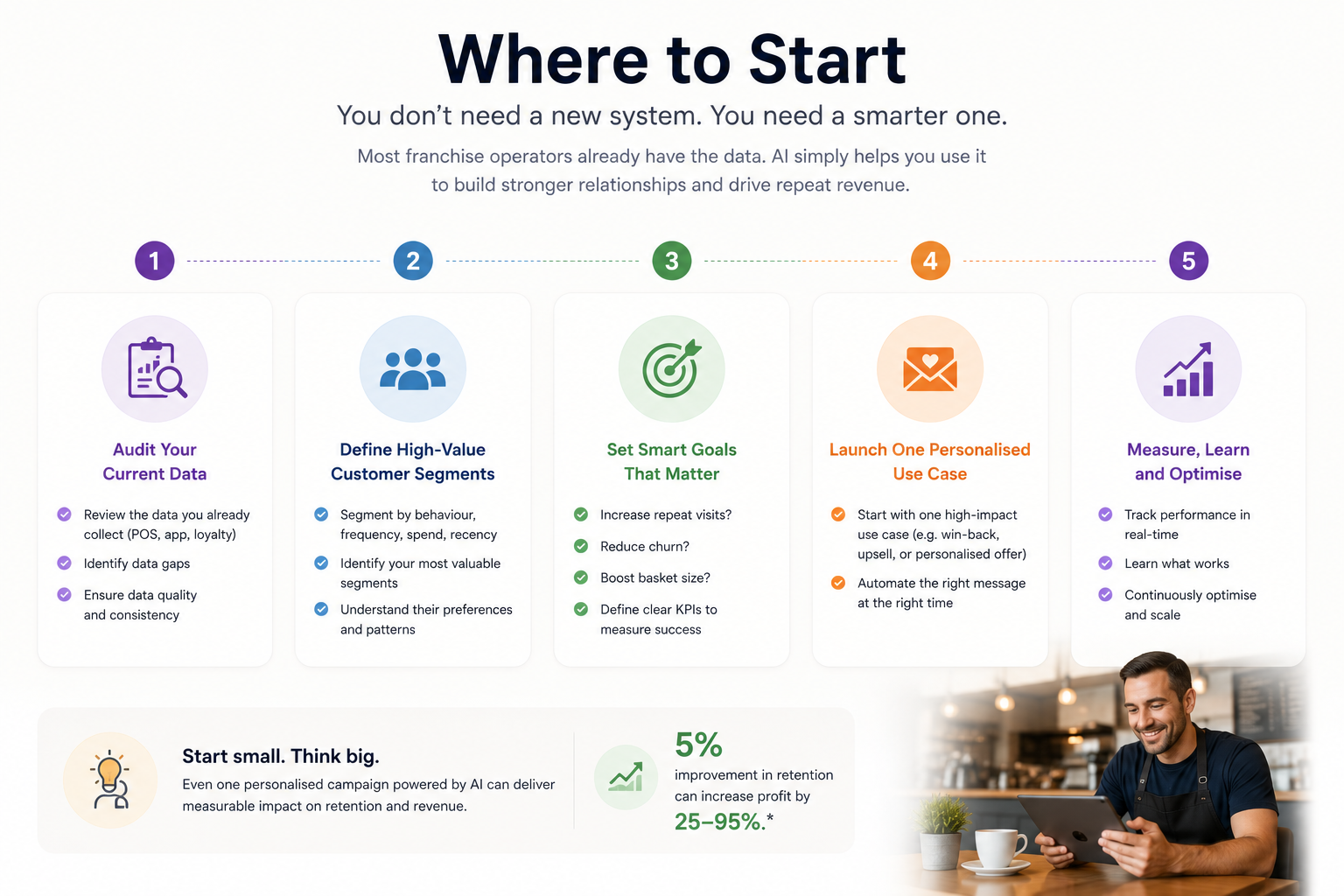
You don’t need to overhaul your entire programme. The highest-impact starting point is almost always the same: re-engagement automation for lapsed members.
It requires no new infrastructure, uses data you already have, delivers measurable ROI within 60–90 days, and lays the foundation for everything that comes next. Build that win. Measure it. Then expand to personalised segmentation, predictive upsell, and AI-powered analytics.
Frequently Asked Questions
How does AI improve a franchise loyalty programme? AI analyses customer transaction data, visit frequency, order history, and time of day to trigger personalised offers, predict which customers are about to churn, and automate re-engagement. It makes your existing programme significantly smarter without requiring new infrastructure or replacing what you already have.
Is AI loyalty technology affordable for single-location franchise owners? Yes. AI loyalty tools that integrate with common franchise POS systems are now available at SMB-friendly price points, often starting below $100/month. Most single-location operators see measurable ROI within 60–90 days through improved retention and upsell performance alone.
What’s the biggest mistake franchise owners make with their loyalty programme? Treating it as a set-and-forget points system. The biggest ROI gap comes from failing to re-engage lapsed customers. Without automated churn detection, customers quietly disappear and the programme collects data that never gets acted on.
How quickly can AI be integrated into an existing franchise loyalty setup? Most AI loyalty integrations with existing POS systems take days to configure, not months. The heavy lifting is in connecting your transaction data once that’s done, personalisation and re-engagement automation can be live within a week.
Which franchise types benefit most from AI loyalty tools? Quick-service restaurants, food and beverage franchises, health and fitness franchises, and any franchise with high visit frequency and repeat customer potential see the strongest results. The more transaction data available, the more effective AI personalisation becomes.
Ready to Make Your Loyalty Programme Actually Work?
At Aximise, we help franchise owners turn their existing loyalty data into a genuine customer retention engine without replacing what you already have or requiring technical expertise on your team.
Whether you’re running a single location or managing multiple franchise units, we’ll map out exactly where AI can close the gap between your current loyalty programme and what it should be doing for your business.
Book a free 30-minute consultation → aximise.com/contact
No jargon. No pressure. Just a clear picture of what’s possible for your franchise.
Aximise is an AI consulting and software development company helping businesses unlock real value from artificial intelligence. Learn more at aximise.com.