

Walk into any retail store today, physical or digital, and you’ll see the same invisible struggle playing out.
A product that’s fully stocked… but no one’s buying.
Another that customers are actively searching for… but it’s already sold out.
At the same time, customers expect every interaction to feel tailored, like the brand already knows what they want, when they want it, and how they want to buy it.
This is the modern retail paradox: Too much inventory in the wrong places, and too little relevance in the right moments.
Despite having access to massive amounts of data, most retailers are still reacting instead of predicting, guessing demand, pushing generic campaigns, and making decisions in silos.
This is where AI changes the equation.
According to McKinsey & Company, retailers that effectively use AI can improve inventory accuracy by up to 35% and increase revenue by 5–10%. Not as another tool or dashboard, but as a system that connects inventory decisions with customer behavior, turning fragmented data into intelligent, real-time action.
Because in retail today, success isn’t just about what you sell. It’s about what you stock, who you show it to, and when it matters most.
Inventory Challenges: Where Retailers Lose the Most
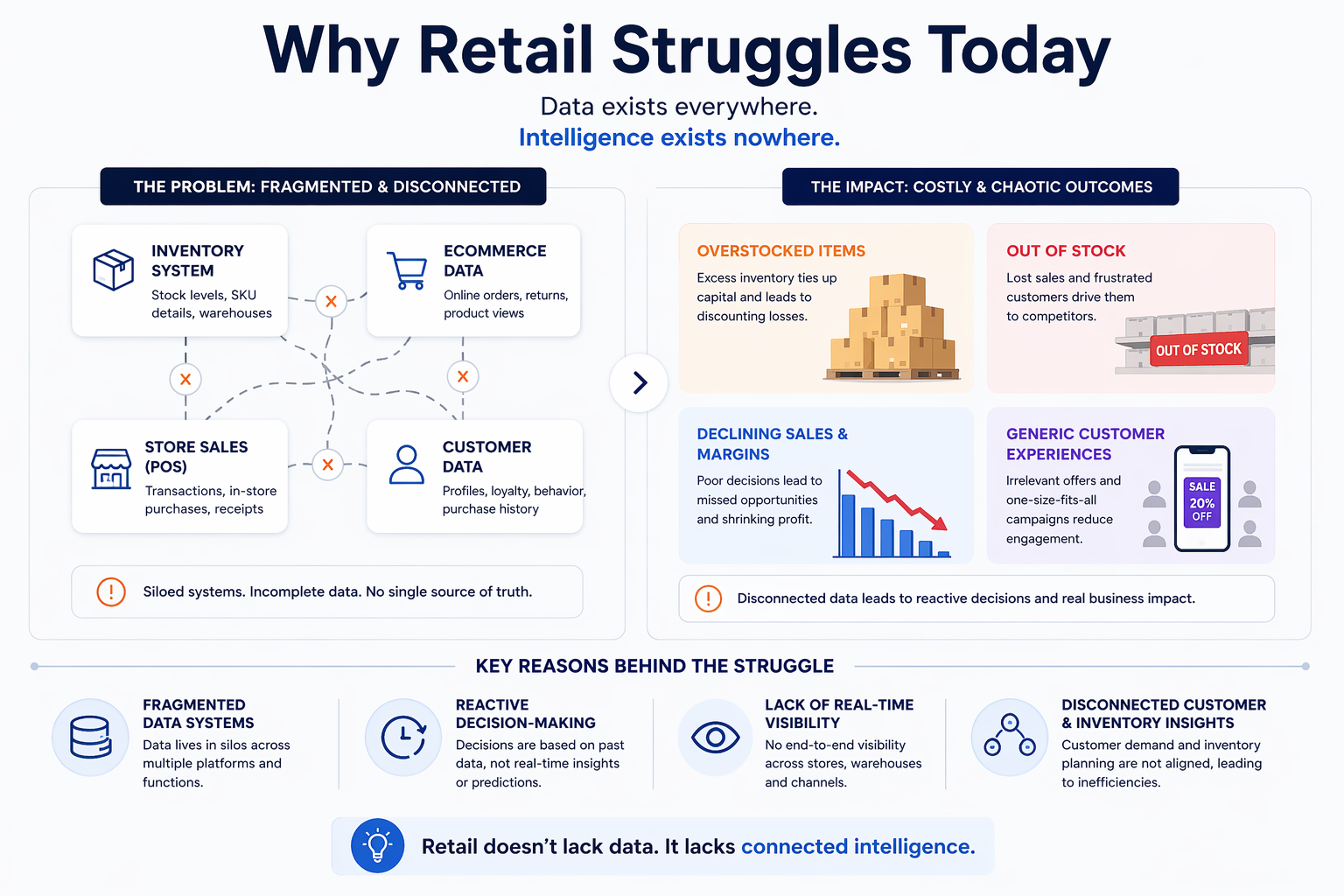
Inventory inefficiencies are not just operational issues; they directly impact revenue, margins, and customer trust. According to IHL Group, retailers lose over $1.75 trillion annually due to stockouts, overstocks, and returns.
- Overstocking → Capital Lock + Margin Erosion: Excess inventory ties up working capital that could be used elsewhere in the business. To clear unsold stock, retailers are forced to offer heavy discounts, directly impacting profitability and brand value.
- Stockouts → Missed Revenue + Poor Customer Experience: When high-demand products are unavailable, retailers don’t just lose a sale, they risk losing the customer altogether. Repeated stockouts erode trust and drive customers to competitors.
- Poor Demand Forecasting: Traditional forecasting relies heavily on historical data, often ignoring real-time signals like trends, seasonality shifts, or external factors. The result: decisions that are always a step behind actual demand.
- Inefficient Replenishment Cycles: Manual or delayed replenishment processes lead to either over-ordering or under-ordering. Without dynamic adjustments, inventory flow becomes reactive instead of optimized.
- Lack of Real-Time Visibility Across Channels: With multiple sales channels (online, offline, marketplaces), inventory data often exists in silos. This leads to inconsistencies, inaccurate stock levels, and missed opportunities to fulfill demand efficiently.
Transition: Inventory is not a supply chain problem anymore; it’s a prediction problem.
How AI Transforms Inventory Management (A Systems View)?
Traditional inventory management operates in fragments, forecasting in one system, warehouse data in another, and store-level decisions happening independently. AI changes this by bringing everything into a single, connected layer where decisions are not just informed, but continuously optimized.
Instead of relying only on past sales, AI-driven demand forecasting incorporates multiple signals, such as historical patterns, seasonal shifts, weather conditions, local events, and emerging trends. This allows retailers to move beyond static predictions and respond to demand as it evolves.
At the same time, real-time inventory tracking ensures that every unit, whether in a warehouse, store, or in transit, is visible across the system. This visibility eliminates guesswork and enables smarter allocation decisions, especially in multi-channel environments.
Replenishment, which was once manual and periodic, becomes automated and adaptive. AI continuously monitors demand and stock levels, triggering replenishment at the right time and in the right quantity, reducing both overstocking and stockouts.
Dynamic pricing adds another layer of intelligence. Instead of reacting to excess inventory with blanket discounts, AI adjusts pricing strategically based on demand patterns, product lifecycle, and customer behavior, helping retailers protect margins while clearing stock efficiently.
Crucially, AI also enables optimization at different levels from individual stores to centralized warehouses. What works for one location may not work for another, and AI accounts for these variations, ensuring inventory decisions are localized yet aligned with overall business goals.
From an Aximise perspective, the real transformation lies in how these elements come together.
AI doesn’t just improve individual functions; it connects them.
It creates a unified decision layer where data flows seamlessly across systems, enabling retailers to move from:
- What happened? (reporting)
- To what will happen? (prediction)
- To what should we do? (actionable intelligence)
Personalization Challenges: The Other Half of the Problem
While inventory determines what’s available, personalization determines what actually gets sold.
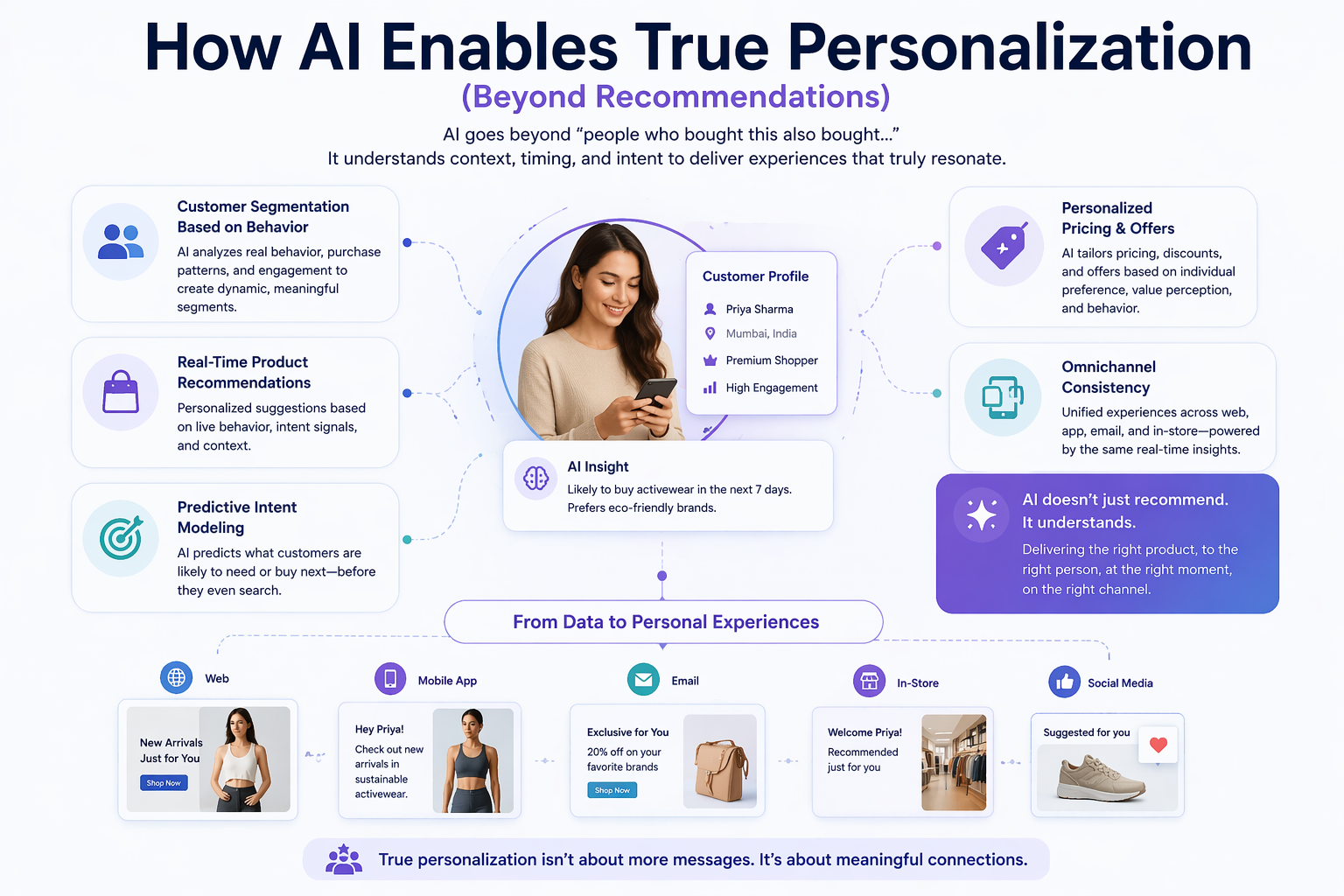
Today’s customers expect more than just product availability; they expect relevance. Whether they’re browsing online, visiting a store, or interacting through an app, they want experiences that feel tailored to their preferences and behavior.
This includes:
- Recommendations that make sense to them
- Offers that arrive at the right moment
- A seamless experience across channels, without disconnects
However, most retailers struggle to meet these expectations.
Marketing campaigns are often still designed for broad segments rather than individuals. Customer journeys remain fragmented, with different touchpoints operating in isolation. Promotions tend to follow a one-size-fits-all approach, ignoring each customer’s intent and behavior.
The result is a disconnect between what customers expect and what they experience.
At its core, this is not just a marketing challenge. It’s a data and behavior problem.
Retailers often treat personalization as a front-end activity focused on messaging and campaigns, while the real opportunity lies deeper. True personalization requires understanding patterns, predicting intent, and responding in real time.
Without a connected system that brings together customer data, behavior signals, and decision logic, personalization remains surface-level and ultimately ineffective.
The Real Power: Connecting Inventory + Personalization
Most retailers operate with a fundamental disconnect.
Inventory decisions are made based on supply chain logic.
Personalization decisions are driven by marketing teams.
Both are important. But when they function in isolation, they create inefficiencies, excess stock on one side, irrelevant customer experiences on the other.
AI changes this by bringing both sides into the same decision system.
Instead of treating inventory and personalization as separate functions, AI connects product availability with customer intent, ensuring that what is stocked aligns with what is promoted, and what is promoted aligns with what is likely to convert.
This is where the real value begins to show.
For example, when certain products are overstocked, the solution is no longer blanket discounting. AI identifies the right customer segments, those most likely to purchase, and targets them with relevant recommendations or offers. The outcome is not just inventory clearance, but smarter, margin-conscious selling.
Pricing also becomes more intelligent. Instead of reacting purely to supply levels, AI adjusts pricing dynamically by considering both demand signals and customer behavior, willingness to pay, purchase history, and engagement patterns. This creates a balance between maximizing revenue and maintaining customer relevance.
On a broader level, supply chain decisions themselves become demand-aware. Inventory allocation, replenishment, and even product assortment can be guided by real customer behavior patterns, not just forecasts in isolation. Stores are stocked not based on averages, but based on localized demand signals tied to actual customer intent.
The shift here is subtle, but powerful.
Retail moves from managing products and marketing customers…
to managing a connected system where both influence each other in real time.
Key Insight: The real value of AI in retail is not optimization in silos, it’s coordination across systems. Because when inventory and personalization start working together, retailers don’t just reduce inefficiencies, they create experiences that are both operationally smart and commercially effective.
Most retailers today don’t lack data. They lack a system that can turn that data into intelligent action.
At Aximise, we design AI systems that go beyond dashboards, connecting inventory, customer behavior, and decision-making into a unified, real-time layer.
Because real transformation doesn’t come from adding more tools. It comes from building systems that think, adapt, and execute.
If you’re looking to move from reactive operations to intelligent retail, let’s start with a conversation.
FAQ
- How does AI help in retail inventory management?
AI improves inventory management by forecasting demand, tracking stock in real time, automating replenishment, and reducing both overstocking and stockouts. - What is AI-powered personalization in retail?
AI-powered personalization uses customer data and behavior patterns to deliver tailored product recommendations, offers, and experiences across channels. - What are the main challenges in retail inventory?
The biggest challenges include overstocking, stockouts, inaccurate demand forecasting, lack of real-time visibility, and inefficient replenishment systems. - Why should inventory and personalization be connected?
Connecting both ensures that the right products are promoted to the right customers at the right time, improving conversions and reducing inventory waste. - Is AI in retail only for large enterprises?
No. With scalable tools and platforms, AI can be adopted by mid-sized and growing retailers to improve efficiency and customer experience.